
Item: Mandala of Chakrasamvara (Buddhist Deity)
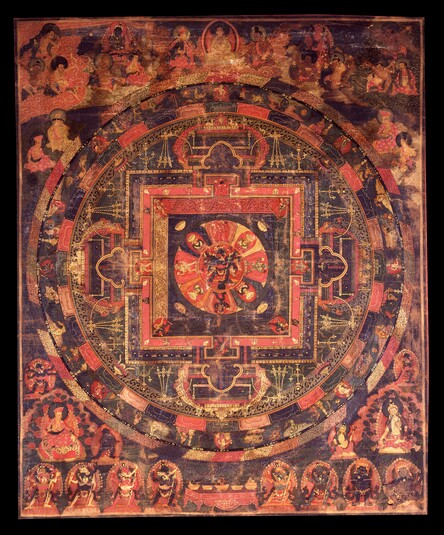
| Origin Location | Himalayan Region |
|---|---|
| Date Range | 1600 - 1699 |
| Lineages | Kagyu and Buddhist |
| Size | 45.72x38.10cm (18x15in) |
| Material | Ground Mineral Pigment on Cotton |
| Collection | Rubin Museum of Art |
| Catalogue # | acc.# F1997.26.2 |
Classification: Deity
Chakrasamvara Thirteen Deity Mandala according to the tradition of Maitripa (Tibetan: khor lo dem chog lha chu sum gyi kyil kor. English: the Wheel of Supreme Bliss) with lineage teachers at the top and retinue figures and protectors below. This form of Chakrasamvara originates from the Abhidhana Uttaratantra [TOH 369].
Chakrasamvara is the name of an important and complex Buddhist meditational deity. Here complex refers to the appearance of the deity. Chakrasamvara typically is depicted with multiple faces and arms. The name means 'wheel of supreme bliss' and is understood on multiple levels of symbolic meaning which is common in Tantric Buddhism.
At the top center wearing a white garment is the famous Tibetan yogi Milarepa with Padmasambhava on his right and Tsangnyon Heruka on the left. To the viewers left are Vajradhara, Nagarjuna, Saraha, Shavaripa and two unidentified Indian siddhas. Below that are Rechungpa and Pagmodrupa. To the viewers right are Vajrayogini, Virupa, Ghantapa, Naropa, Marpa and an unidentified siddha. Below that are Gampopa and Ling Repa.
At the lower left is a three-faced, six armed, form of Chakrasamvara, an unidentified Kagyu teacher and the wealth deity Black Jambhala. At the lower right is Sahaja Heruka Chakrasamvara, and what appears to be a White Manjushri and a small image of Sarasvati holding a vina.
In the bottom right corner is Chaturbhuja Mahakala the special protector for the Chakrasamvara cycle of Tantras and Tantric practice. Standing next to Chaturbhuja is Panjarnata Mahakala associated with the Hevajra Tantra. To the left are six retinue figures belonging to the internal yoga practices related to the central Chakrasamvara mandala above.
For a drawing of this mandala see HAR #58254.
Jeff Watt 10-2008
Mandala: Mandala Main Page
Collection of Rubin Museum of Art: Painting Gallery 2
Painting Style: Tibet (Balri)
Collection of Rubin Museum of Art: Mandala
Buddhist Deity: Chakrasamvara Mandala