
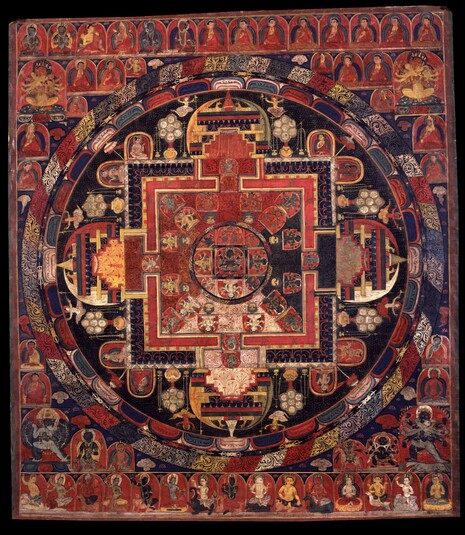
Item: Mandala of Guhyasamaja (Buddhist Deity) - Akshobhyavajra
གསང་བ་འདུས་པ། ནང་ལྷ།
密集金刚(佛教本尊)
(item no. 620)
| Origin Location | Tibet |
|---|---|
| Date Range | 1500 - 1599 |
| Lineages | Sakya, Gelug and Buddhist |
| Size | 67.31x59.06cm (26.50x23.25in) |
| Material | Ground Mineral Pigment on Cotton |
| Collection | Rubin Museum of Art |
| Catalogue # | acc.# F1998.7.1 |
Notes about the Central Figure
Akshobhyavajra, Guhyasamaja (Tibetan: mi kyo dor je, sang wa du pa. English: the Unshakeable Scepter, Secret Assembly): depicted in the center of a mandala, the principal deity of the Father (Method) classification of Anuttarayoga Tantra of Tantric Buddhism.
Peaceful in appearance, with a stern expression, blue in colour, he has three faces and six hands, embracing the consort. Lineage teachers are seated along the top and descend at the sides.
Guhyasamaja has two main traditions, the Arya (Nagarjuna) Lineage and the Jnana (Jnanapada) Lineage. The subject of this painting is the Arya Lineage. Of the three types of Anuttarayoga Tantra this is the chief of the 'Method' (Father) class.
Jeff Watt 9-2003
Mandala: Mandala Main Page
Tradition: Gelug Deity Paintings
Collection of Rubin Museum of Art: Painting Gallery 3
Buddhist Deity: Guhyasamaja Main Page
Painting Style: Tibet (Balri)
Tradition: Gelug Mandalas
Mandalas: Gelug Tradition
Buddhist Deity: Guhyasamaja, Akshobhyavajra
Collection of Rubin Museum of Art: Mandala
Tradition: Gelug Early Mandala
Copyright © 2026
Himalayan Art Resources Inc.
Photographed Image Copyright © 2004 Rubin Museum of Art