
Item: Padmasambhava - (Main Form)
| Origin Location | Tibet |
|---|---|
| Date Range | 1800 - 1899 |
| Lineages | Nyingma and Buddhist |
| Material | Ground Mineral Pigment on Cotton |
| Collection | Rubin Museum of Art |
Padmasambhava (Tibetan: pe ma jung ne, English: Lotus Born): the main founder of Buddhism in Tibet. (See Padmasambhava Life-story Painting).  Pemasambhava Pema Jungne
  Biographical Details
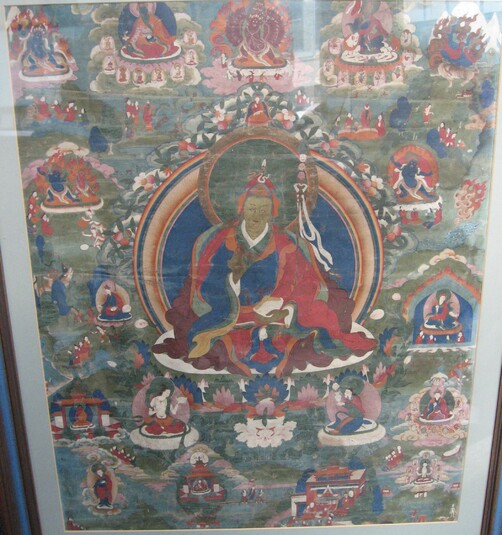
With a steady composure gazing forward, gold in colour, one face, the right hand holds to the heart an upright gold vajra. The left hand placed in the lap holds a white skullcup. The ornate katvanga staff of a Tantric practitioner, decorated with white streamers, rests against the left shoulder. Adorned with gold earrings and a necklace, the head is covered with a lotus hat, a gift of the King of Zahor, of silk brocade topped with a half-vajra and a single vulture feather. Attired in various robes of different colours reflecting the disciplines of the Vinaya, Bodhisattva and Mantra Vehicles, he sits atop a sun and moon disc above a multi-coloured lotus blossom rising from the blue waters of Dhanakosha lake; encircled by a rainbow sphere. Seated at Padmasambhava's right is the consort Mandarava holding a skullcup. the long-life symbols of an arrow with a mirror and streamers in the right hand and a vase in the left. At the left is the consort Yeshe Tsogyal holding an arrow and long-life vase.
"Miraculous buddha arising from a lotus, unborn, undying, possessing a vajra body, performing the activity of all buddhas of the three times; homage to Padmasambhava." (Nyingma liturgical verse).
Padmasambhava is surrounded by narrative vignettes relating aspects of his life-story according to the Terma (Revealed Treasure) Tradition. At the top of the composition are five meditational forms of Padmasambhava.
Credited as one of the three principal individuals to bring Buddhism to Tibet in the 8th century, Padmasambhava, commonly referred to as Guru Rinpoche meaning 'precious teacher' has numerous forms representing outer, inner and secret aspects of his divine being. Within the Kama (Oral) Tradition of the Nyingma Tradition, Padmasambhava was born in Northern India as the son of a king or minister. In the Terma (Treasure) Tradition he was born on a lotus in Dhanakosha lake as an emanation of the Buddha Amitabha.
Jeff Watt 10-2007
Padmasambhava Main Page
Collection of Rubin Museum of Art: Painting Gallery 4
Padmasambhava: 'Revealed Treasure'
Padmasambhava: Ngari Panchen Yontan Terdzo