
Item: Chakrasamvara (Buddhist Deity)
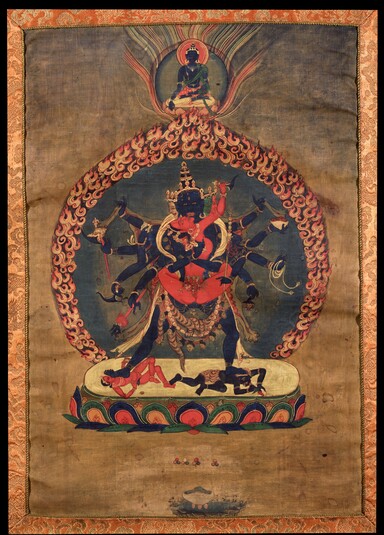
| Origin Location | Eastern Tibet |
|---|---|
| Date Range | 1700 - 1799 |
| Lineages | Karma (Kagyu) and Buddhist |
| Size | 32.39x22.23cm (12.75x8.75in) |
| Material | Ground Mineral Pigment, Fine Gold Line on Cotton |
| Collection | Rubin Museum of Art |
| Catalogue # | acc.# F1997.3.4 |
Classification: Deity
Shri Chakrasamvara (Tibetan: khor lo dem chog, English: Wheel of Supreme Bliss): the foremost tutelary deity of the Wisdom-mother classification of Anuttarayoga Tantra. The painting was commissioned by Naljorma Dechen Wangmo and the four-line verse of blessing on the back was written by Kagyu Tanpa'i Gyaltsen. In this case the the commissioner is likely to be the yogini Dechen Wangmo, who lived in the late 18th, early 19th century in Eastern Tibet. She was a highly regarded Buddhist practitioner and a student of the 8th Gyalwang Drugchen Rinpoche, Kunzig Chokyi Nangwa, head of the Drugpa Kagyu Tradition of Tibetan Buddhism.
Tibetan: Khor lo dem chog
With a body blue in colour he has four faces and twelve arms. The main face is blue, left green, back face red and the right face white. Each face has three eyes, a gaping mouth and four bared fangs. The first two hands hold a vajra and bell and embrace the consort. The last two hold an elephant skin out-stretched, third right a damaru, fourth an axe, fifth a trident, sixth a curved knife. The third left holds a katvanga marked with a vajra, fourth a vajra noose, fifth a blood filled skullcup, sixth carries the four-faced head of Brahma. The hair is tied in a topknot on the crown of the head. Each head has a crown of five dry human skulls and he wears a necklace of fifty freshly severed heads and six bone ornaments. Wearing a lower garment of tiger skin the right leg is straight and presses on the breast of the red female Kalaratri. The left is bent and presses on the head of the black male Yama. In the lap is the Mother Vajravarahi, with a body red in colour, one face, two hands and three eyes. The left embraces the Father and the right holds a curved knife extended upwards. The hair is worn piled on the head with a crown of five dry human skulls and fifty dry as a necklace. She embraces the Lord with both legs. Atop a sun disc and multi-coloured lotus blossom they stand in the middle of a blazing orange ring of pristine awareness fire. Precious jewels and an offering skullcup adorn the foreground.
At the top center is the buddha of the Vajra Family, Akshobhya, 'the Unshakable One' blue in colour with one face and two hands. The right hand performs the mudra of 'earth witness' and the left placed in the lap in the mudra of meditation supports an upright gold vajra. He wears a crown, jewel ornaments and garments of a Sambhogakaya (enjoyment body) level buddha; seated on a pink lotus blossom and wreathed by rainbow lights.
The deity Chakrasamvara is common to all the Sarma Schools of Sakya, Kagyu and Gelug. Within the latter he is commonly referred to as 'Heruka.' Among the many different forms and mandalas of practice this figure of Vajravarahi entwining the consort with both legs is common to the traditions of mahasiddha Luipa and Maitripa.
Jeff Watt 1-99
Front of Painting
English Translation of Inscription: [No inscriptions visible on the front]
Reverse of Painting
Wylie Transliteration of Inscription: gsang chen ston pa dkyil 'khor kun gyi gtso. he ru ka dpal bde mchog btsun mor bcas. mnyam sbyor zung bsdug chen por gus 'dud do. skye kun bla ma he ru ka 'grub shog. cas pa yang rje btsun rnal 'byor ma bde chen dbang mo'i dad rten du. bka' brgyud bstan pa'i rgyal mtshan kyis bris pa. manga lam.
Special Features: (Cursive script (Umay))

Subject: Trampled Gods & Deities Page (Numbers)
Painting Style: Minimalism & Minimalist Landscape
Painting Style: Minimalist (Drugpa Kagyu, Lhatog)
Tradition: Kagyu Deity Paintings
Collection of Rubin Museum of Art: Painting Gallery 2
Buddhist Deity: Chakrasamvara Main Page
Painting Style: Kham Region (Kham-ri)
Collection of RMA: Best of Collection 3
Subject: Meditational Deities (ishtadevata, yi dam)
Subject: Name Inscription - Misidentified or Name Added
Artist: Kunzig Chokyi Nangwa