
Item: Indian Adept (siddha)
| Origin Location | Tibet |
|---|---|
| Date Range | 1300 - 1399 |
| Lineages | Kagyu and Buddhist |
| Material | Ground Mineral Pigment on Cotton |
| Collection | The Metropolitan Museum of Art |
Classification: Person
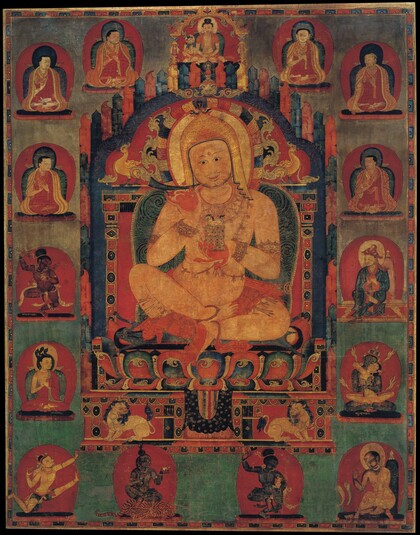
Jnanatapa, an Indian siddha, surrounded above by Tibetan lineage teachers and below by the Eight Great Siddhas. (See a Jnanatapa sculpture HAR #4802).
Sanggye Yarjon, 3rd Abbot (1203-1272) p1818 is second on the top right side.
The Eight Great Siddhas are depicted in the bottom half of the painting on the left and right vertical registers. At the middle left is Saraha, brown in colour, in a dancing posture, holding two arrows in the right hand and a vase in the left. Below Saraha is Nagarjuna in the robes of a monk and a hood of three snakes. Below that is Ghantapa, holding a vajra and bell, leaping into the air. Next to him is Dombi Heruka, dark in colour, riding a tigress. At the middle right is King Indrabhuti dressed in royal attire. Below that is Padmavajra embracing a consort. Below that is Luipa with two fish displayed in front. Next to him is Kukkuripa, dark in colour, dancing, and holding a dog.
There is no Virupa or Lawapa in this system of eight siddhas.
Numbered List:
Saraha Nagarjuna Ghantapa Dombi Heruka Indrabhuti Padmavajra Luipa Kukkaripa
Jeff Watt 6-2006 [updated 12-2024]

Publication: Sacred Visions
Thematic Sets
Subject: Eight Siddhas (Eight Great Adepts)
Subject: Eight Siddhas In One Painting
Collection of The Metropolitan Museum of Art: Main Page
Indian Adept: Alternate Central Figure Compositions (for 8 & 84 Mahasiddhas)
Indian Adept: Jnanatapa
Indian Adept (Mahasiddha): Painting
Subject: Greyscale - Figurative & General Composition
Indian Adept: Systems of Mahasiddhas
Indian Adept: Siddha Appearance Masterworks (Painting)
Indian Adept (Mahasiddha): Painting (Early Period 11th-14th)
Indian Adept: Three Groupings
Exhibition: Mandalas, Mapping the Buddhist Art of Tibet (Teachers)
Painting Style: Minimalism & Minimalist Landscape
Definition: Mahasiddha (Three Meanings of the Term)