February 06, 2012 · By Himalayan Art Resources · No Comments
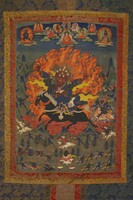
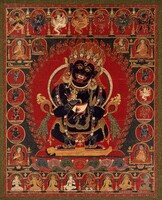
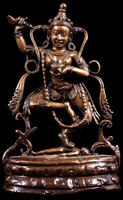
The Svarodaya Manuscript is of Shaiva origin thought to originate in Kashmir over a millennium ago. It is essentially a book of magic and tied very closely to astrology and the astrological magic of India. The subject of the text is also sometimes referred to as martial magic because of its origin in relation to a battle between the God Realm and the Asura Realm. The great Indian God Shiva is credited with the creation of the Svarodaya manuscript. The source of the text is a dialogue between Shiva and Shakti.
Many of the approximately 130 magical and astrological practices in the manuscript relate to marriage, harvest, child birth, and the many other normal and typical subjects associated with Indian magic.
The manuscript entered the Tibetan Buddhist world via Jumla in West Nepal and brought to Tibet where it was popularized amongst some family lineage groups. The text enjoyed a much greater popularity at the time of Desi Sanggye Gyatso in the 17th century. The subject of the Svarodaya was included in the monumental work of the Vaidurya Karpo (White Beryl) treatise on Tibetan astrology.
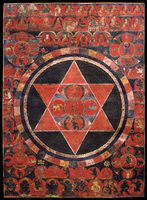
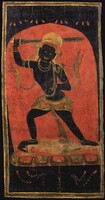
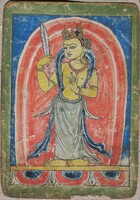
An early block print text of the Svarodaya from the 17th century contains many of the magical images - in the text they are called chakras. Several hand written manuscripts with some drawings included amongst the pages are also known to exist (see example). Two separate and unique large scrolls depicting all of the images of the Svarodaya have been identified along with a fully illuminated folio text with a drawing style very closely related to the Svarodaya scroll on the HAR website.
Tags:
additions
February 05, 2012 · By Himalayan Art Resources · No Comments
The Nyingjei Lam Collection has been updated and the various subject categories have been divided into separate and easy to browse pages.
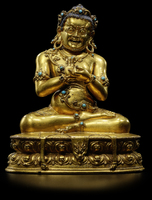
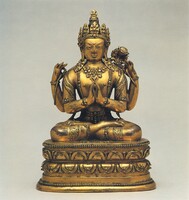
The collection includes outstanding examples of Tibetan sculpture as well as works from Eastern India, Kashmir and Nepal. A great strength of the collection is the exquisite portrait bronzes. (See Nyingjei Lam on the Asian Art web site).
Subject Categories:
1. Buddhas
2. Indian Teachers
3. Tibetan Teachers
4. Deities
5. Protectors
6. Miscellaneous
Tags:
collections · Sculpture · updates
January 31, 2012 · By Himalayan Art Resources · No Comments
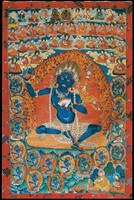
Buddhakapala, meaning the skull of the enlightened one, is a meditational deity belonging to the Wisdom Class, or Mother Tantra, of Anuttarayoga Tantra of Tantric Buddhism.
There are several different forms of Buddhakapala. Sometimes he appears with a consort and sometimes without. He can appear in single aspect or with a mandala of eight or twenty-five retinue deities.
In the most basic form Buddhakapala appears as described below.
"Buddhakapala is blue with one face and four arms. The right two hold a double-sided drum and a curved knife. The left two hold a skullcup and a katvanga staff. Having three eyes and the pile of hair adorned with a vishva-vajra and crescent moon, a crown of five dry skulls and a necklace of fifty wet, adorned with the six mudras, an elephant hide as a lower garment, standing in a dancing manner, half vajra, expressing the nine moods of dance. [He] embraces the consort Vishvasukha Matri, red, [holding] in the right a curved knife and a skullcup in the left embracing the Lord, surrounded by the eight goddesses." (Based on Ocean of Meditational Deities text of Taranata, 1575–1634).
Tags:
additions · updates
January 30, 2012 · By Himalayan Art Resources · No Comments
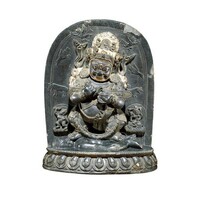
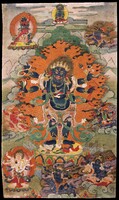
This form of Chaturmukha Mahakala, with minor differences in detail from the Sakya form, was created by Terdag Lingpa Gyurme Dorje at the request of five monks from the Lhukang Temple.
The two examples below are somewhat different in detail from each other although both of the iconographic forms follow the general description of Chaturmukha as written in the text of Terdag Lingpa. The coloured image is of a small mural from an equally small protector chapel in Mindrolling Monastery in Tibet.
Tags:
January 27, 2012 · By Himalayan Art Resources · No Comments
Mahakala, Chaturmukha (Four-faced Great Black One) associated with the Guhyasamaja Tantra along with the Twenty-five and Fifty Chapter Mahakala Tantras. Aside from the Sarma Tradition Chaturmukha later Nyingma Revealed Treasure Traditions (terma) of Chaturmukha arose.
According to the Sakya Tradition this form of Mahakala with four faces and four arms is rarely depicted in art and virtually never shown to those who are uninitiated. The early Sakya Teachers devised a simplified form of the deity to be depicted on paintings as a place card-holder for the true image and form which was considered too secret and dangerous to display publicly. The simplified form is that of what has come to be known as Brahmanarupa Mahakala. (See below for a short history).
Tags:
additions · updates
January 23, 2012 · By Himalayan Art Resources · No Comments
Drogdze Wangmo, (English: the Powerful Friend): protector of the Nyingma Terma (Treasure) Tradition. This protector deity was popularized in the 18th and 19th centuries by the Mindrolling Tradition of Tibetan Buddhism.
"...One Mother, Mistress of the Three Realms, with a body maroon in colour, ferocious and frightful in appearance, with one face and two hands. In the right, eating the heart of an enemy, blood dripping and warm. Reflecting the Three Realms - the left holds a mirror. Wearing an upper garment of white silk, a tiger skin lower garment and a fresh human skin cloak. Dark brown hair hanging downward, earrings, a crown of five dry skulls and a necklace of fifty fresh, a garland of bones and a long necklace; standing haughtily with the left leg extended..." (Min-ling Lochen Dharmashri, 1654-1718. Tibetan source text TBRC W18, part II, pp.261-262).
Tags:
Protectors · updates
January 21, 2012 · By Himalayan Art Resources · No Comments
The incarnation line of the Panchen Lama is a popular subject in Tibetan art. The majority of Panchen Lama paintings found in museum and private collections originate in the early 18th century with a single set of drawings and subsequent block prints. They are believed to be created at the famous printing house of Nartang Monastery (just West of Shigatse and Tashi Lhunpo Monastery).
A complete example of a painted set of compositions belongs to the collection of Tibet House, New Delhi.
The Nartang set does not contain Amitabha, Padmasambhava or Atisha. Therefore, the set does not begin with Amitabha but rather most likely uses, as the central image, the current (for the time) Panchen Lama. All of the other previous incarnations would properly hang to the right and left side of the current and centrally positioned Panchen Lama. It would seem probable that at the time of the creation of the Nartang set it ended with the 2nd Panchen Lama Lobzang Yeshe (1663-1737).
Tags:
additions
January 21, 2012 · By Himalayan Art Resources · No Comments
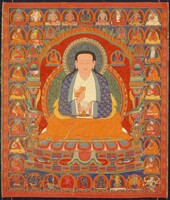
The images below represent the incarnation line of Panchen Lamas in a single composition. Three of the paintings are very good examples that clearly depict different artistic styles. Two of those paintings are also exceptional because of the portrait quality of the facial features of the central figures.
Tags:
additions
January 20, 2012 · By Himalayan Art Resources · No Comments
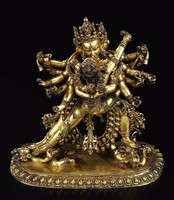
The Milarepa Main Page has been updated with additional images.
Tags:
additions · updates
January 18, 2012 · By Himalayan Art Resources · No Comments
As a sub-theme of the Five Forms of Tsongkapa, the mahasiddha form is sometimes depicted as the central figure of a composition surrounded by smaller figures of the Eighty-four Mahasiddhas. So far six paintings have been identified with four of them included on the HAR website.
Two of the HAR images belong to sets likely likely including depictions of the other forms of Tsongkapa: HAR #65347, 77237. Three of the remaining paintings appear to have all been created based on a single model. Two of these are HAR #74042 and 90748. All of the individual compositions and sets of paintings identified thus far depict the Eighty-four Mahasiddhas according to the Vajrasana System.
Tags:
iconography · updates