
Item: Teacher (Lama) - Shamarpa 10, Mipam Chodrub Gyatso
| Origin Location | Eastern Tibet |
|---|---|
| Date Range | 1700 - 1799 |
| Lineages | Kagyu, Karma (Kagyu) and Buddhist |
| Size | 63.50x40.64cm (25x16in) |
| Material | Ground Mineral Pigment on Cotton |
| Collection | Rubin Museum of Art |
| Catalogue # | acc.# F1997.13.1 |
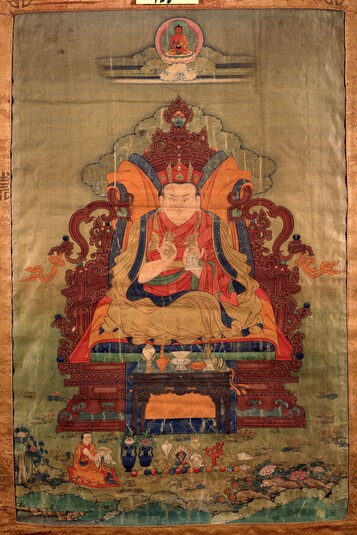
Mipam Chodrub Gyatso, the 10th Shamarpa (1742-1792); holding a vajra and bell to the heart, he stares with a grimace and wears the red vajra hat.
 Sha mar pa
  Biographical Details

One of the most controversial figures in recent Himalayan history is Shamarpa, the 10th Red Hat Lama of Kamtsang Kagyu (Oral Tradition). Belonging to a wealthy and influential family, Shamarpa was the brother of the 3rd Panchen Lama. After the passing of the Panchen Lama, an unresolved dispute over family inheritance with a younger brother caused Shamarpa to leave central Tibet and eventually arrive in Nepal. Associated with the Nepalese Gurkha invasion of Tibet that was repelled by the Chinese Imperial Army, Shamarpa was believed by the Tibetan government to have committed treason. From that time until the 1950s, the incarnation line of the Shamarpa has been banned by the Tibetan Government in Lhasa. In the early 1950s, a new reincarnate lama of the Shamar lineage, the 12th Shamar, was discovered and enthroned by the 16th Karmapa.
This portrait, likely painted during his lifetime, is a good example of the new painting style which appears to be coming out of the Dege Region of Kham and specifically the Palpung Monastery of Situ Panchen Chokyi Jungne.
Jeff Watt 11-2000
Iconography Main Page
Bibliography: Iconography Publications
Thematic Sets
Incarnation Lineage: Shamarpa Main Page
Painting Set: Karma Kagyu Lineage (Sertreng, misc.)
Tibet: Yangpachen Monastery
Teacher: Shamar 10th, Chodrub Gyatso
Teacher: Shamarpa (Paintings)
Painting Style: Palpung Monastery
Painting Style: Palpung - Teachers & Siddhas
Teacher: Shamarpa (Masterworks)
Painting Style: Palpung Monastery (Masterworks)
Collection of RMA: Painting Masterworks Page
Collection of RMA: Persons Masterworks
Subject: Teachers Masterworks Page
Tradition: Marpa/Dagpo Kagyu Iconography
Subject: Hats (Karma Kagyu)
Subject: Hats (Cap Style)
Subject: Hats (Kagyu)
Tradition: Marpa/Dagpo Kagyu Masterworks
Collection of Rubin Museum of Art: Painting Gallery 2
Tradition: Kagyu Teachers (Paintings)
Painting Style: Kham Region (Kham-ri)
Tradition: Karma Kagyu Main Page
Painting Style: Minimalism & Minimalist Landscape