
Item: Mandala of Vajrayogini (Buddhist Deity) - (Naropa Tradition)
| Origin Location | Tibet |
|---|---|
| Date Range | 1800 - 1899 |
| Lineages | Gelug and Buddhist |
| Size | 31.75x31.75cm (12.50x12.50in) |
| Material | Ground Mineral Pigment on Wood |
| Collection | Rubin Museum of Art |
| Catalogue # | acc.# F1997.25.1 |
Classification: Deity
Appearance: Semi-Peaceful
Gender: Female
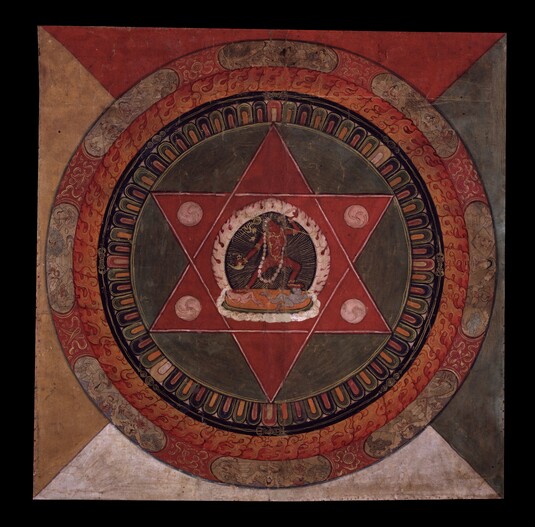
Vajrayogini Mandala (Tibetan: dor je nal jor ma kyil kor). The Dakini Naro Khachodma of the Naropa tradition.
Sanskrit: Vajrayogini Tibetan: Dor je nal jor ma
In the center of two crossed red triangles stands Vajrayogini, red in colour, with one face and two hands. In the left hand, held up to the sky, is a skullcup and in the right a curved knife pointed downward. Naked, adorned with various bone ornaments and a necklace of fifty skulls, she supports against the left shoulder a katvanga staff - decorated with silk streamers. With the two feet placed on the gods Kalaratri and Bhairava, pink and blue, above an orange sun disc and pink lotus she stands completely surrounded by the fires of primordial wisdom.
The two crossed triangles are bordered with a white edge and the two protruding wings on each side contain white circles. The geometric structure is placed in the middle of a green circle surrounded by a ring of lotus petals (Sanskrit: padmavali). Surrounding that is the small blue circle with alternating gold vajras and lines (Skt.: vajravali). Surrounding that is the circle of flames of primordial wisdom (Skt.: jvalavali). In the outermost circle are the eight great charnel grounds each filled with various figures and structures, such as a caitya, tree and lake. Auspicious objects are placed on the red background between the cemeteries. According to the standard convention of mandala drawing the charnel grounds can be placed either between the lotus petal and vajra circles or outside of the circle of flames; both are considered correct.
The distant background is divided into four zones of colour representing the Buddha Families and their respective cardinal directions. For the top is red, west, representing Amitabha; for the right, green, north, and representing Amoghasiddhi; bottom, white, east, Akshobhya; left, yellow, south, Ratnasambhava.
Vajrayogini arises from the Chakrasamvara cycle of Tantras and in this form is one of the 13 Golden Dharmas of Glorious Sakya. In more recent times the practice has gained popularity in the Gelugpa School.
Distant Lineage: Vajradharma, Vajrayogini, Mahasiddha Ghantapada, Tengipa, Antarapa, Tilopa, Naropa, etc.
Near Lineage: Vajradhara, Vajrayogini, Naropa, the Phamtingpa brothers Jigme Dragpa and Ngag gi Wangchug, Lokkya Sherab Tseg, Mal Lotsawa Lodro Dragpa, Sachen Kunga Nyingpo (1092-1158), etc.
Jeff Watt 7-98
Publication: Worlds of Transformation
Thematic Sets
Mandala: Mandala Main Page
Tradition: Gelug Deity Paintings
Collection of Rubin Museum of Art: Painting Gallery 2
Tradition: Sakya Deity Paintings
Buddhist Deity: Vajrayogini Main Page
Tradition: Gelug Mandalas
Mandalas: Gelug Tradition
Buddhist Deity: Deities (Female)
Mandalas: Female Deities
Buddhist Deity: Vajrayogini Mandalas
Buddhist Deity: Vajrayogini, Khechari Manadala
Buddhist Deity: Vajrayogini, Khechara (Naropa Tradition)
Collection of Rubin Museum of Art: Mandala
Mandala: Ritual Mandala Plate (Wood)
Mandala: Vajrayogini Mandala Plate
Mandalas: Cemeteries on the Outside
Buddhist Deity: Vajrayogini Mandala Plate (Naropa)
Subject: Svastika - Bliss Whorl Confusion