
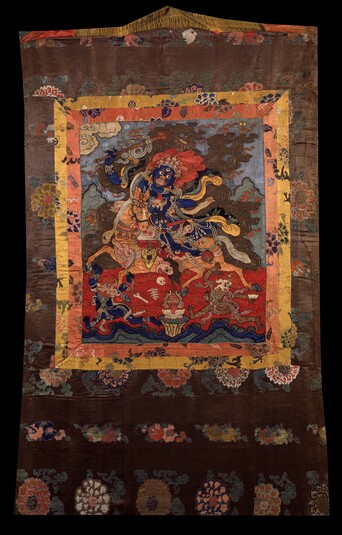
Item: Shri Devi (Buddhist Protector) - Magzor Gyalmo
| Origin Location | Mongolia |
|---|---|
| Date Range | 1700 - 1799 |
| Lineages | Gelug |
| Size | 63.50x50.17cm (25x19.75in) |
| Material | Ground: Textile Image, Embroidery, Applique, Brocade |
| Collection | Rubin Museum of Art |
| Catalogue # | acc.# F1996.19.1 |
Magzor Gyalmo (English: Queen of the Weapon Army): the wrathful emanation of the goddess Sarasvati.
Tibetan: Magzor Gyalmo
Fierce in appearance, with one face and two hands, she holds aloft a stick in the right hand and a skullcup to the heart in the left. She rides a donkey; standing in the middle of an ocean of blood. At the bottom are two attendants. To the left is the 'Makara Faced One,' (a mythical sea creature) blue in colour with one face and two hands; holding a lasso and always placed to the front of the central figure holding the reins of the donkey. To the right is the 'Lion Faced One,' dark red, holding a curved knife and skullcup. This attendant follows behind the mount. Both are adorned with human skins and bone ornaments.
This subject, often commonly ascribed as Shri Devi (who has four hands), is the main attendant to Shri Devi and they are two different deities with different histories and personalities.
She is always a protector and is also used for divination rituals. Most Tibetan Schools have some form of this deity. It is commonly found on Sakya and Gelugpa paintings. This practice was adopted early on as the special protector for the Dalai Lamas and the Namgyal College of the Tse Potala Palace.
Jeff Watt 4-98
Northern Buddhism often prides itself on stating that it has no deities, a statement that does not appear obvious. What is meant here is that the Buddhism of India has created no deities for itself. Implying that it has appropriated deities from other religions. This is a statement from deep within Buddhism and as to proving how valid it is will require careful examination. Based on similarities between Hindu and Buddhist literature and their origin myths, the Glorious Goddess, is undeniably related to the Hindu mother goddess Kali, the wife of Shiva in a wrathful form.
The Glorious Goddess is understood as a class of female protector deity that includes many forms and many different variations on the early origin myth. Some claim that there are twenty-one in number attested to in popular prayer; others say that some of these forms are indigenous to the Himalayas and Tibet. Relying on ancient Tibetan texts, possibly of Indian origin, the Glorious Goddess has a list of one hundred names. Portrayed with four arms, she is considered the principal and original form of the goddess, similar to the Hindu goddess Kali.
The Queen who Repels Armies, appearing with just two arms, is another form within this class. Based on her specific origin myth she is said to be the fearsome manifestation of the Hindu goddess Sarasvati, popular in Hinduism and Buddhism. In the Bon religion Queen of the World is similar to the Buddhist and Hindu forms in both appearance and function.
Jeff Watt 5-2005
Reverse of Painting
English Translation of Inscription: "To the Glorious Goddess I bow."

Exhibition: Female Buddhas at RMA
Publications
Publication: Selection of Works - Painting (RMA)
Thematic Sets
Collection of RMA: Textile Masterworks
Collection of RMA: Mongolia (Painting Masterworks)
Subject: Red Snout-like Nose (Wrathful Deities)
Tradition: Gelug Tradition Main Page
Collection of Rubin Museum of Art: Mongolia
Collection of RMA: Best of Collection 1
Region: Mongolia, Textiles
Buddhist Protector: Shri Devi, Magzor Gyalmo (Rubin Museum)
Buddhist Protector: Shri Devi, Magzorma (Masterworks)
Textile: Main Page
Textile: Masterworks (纺织品, འཐག་དྲུབ་མ།)
Collection of RMA: Shri Devi Masterworks
Buddhist Protectors: Enlightened
Collection of Rubin Museum of Art: Painting Gallery 2
Textile: Appliqué Masterworks
Buddhist Protector: Shri Devi Main Page
Textile: Applique Artwork Main Page
Tradition: Gelug Protectors
Buddhist Protectors: Enlightened (Female)
Buddhist Protector: Shri Devi, Magzor Gyalmo Main Page
Collection of Rubin Museum of Art: Textile Page