
Item: Indian Teacher - Nagarjuna
| Origin Location | Eastern Tibet |
|---|---|
| Date Range | 1800 - 1899 |
| Lineages | Kagyu and Karma (Kagyu) |
| Size | 43.18x30.48cm (17x12in) |
| Material | Ground Mineral Pigment, Fine Gold Line on Cotton |
| Collection | Rubin Museum of Art |
| Catalogue # | acc.# F1997.41.1 |
| Painting School | Palpung / Situ |
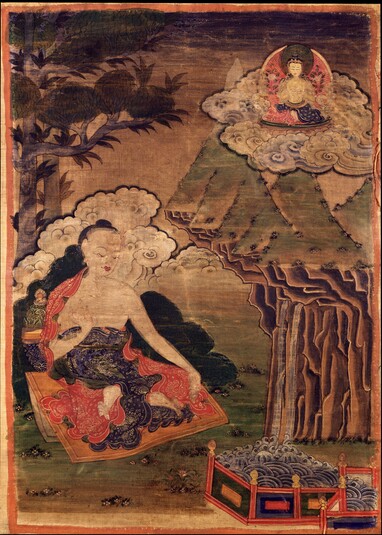
Nagarjuna, Arya (Tibetan: pag pa lhu drup): founder of the philosophical system known as Madhyamaka, the Middle Way School. His exact dates are not known but it is generally believed he lived around the time of the 1st and 2nd centuries C.E.
Relaxed in appearance, he wears the robes of a fully ordained monk and with the right hand raised performs the gesture of blessing. The left hand is extended outward in the gesture of generosity. The waterfall and pond at the lower right are a visual reference to Nagarjuna having received the Prajnaparamita Sutra from the under water realm of Naga spirits. At the top right is the bodhisattva Manjushri, yellow in colour, with the two hands performing the gesture of teaching.
The composition of this painting is based on a set of 9 paintings created by Situ Panchen Chokyi Jungne (1700-1774).
Jeff Watt 6-2003
Publication: Worlds of Transformation
Thematic Sets
Indian Adept: Mahasiddha Paintings, Palpung Composition
Collection of Rubin Museum of Art: Painting Gallery 3
Painting Set: Mahasiddhas, Indian Adepts - Palpung Composition II
Subject: Indian Scholars (Buddhist)
Painting Style: Kham Region (Kham-ri)
Indian Scholar: Nagarjuna Main Page