
Item: Manjushri (Bodhisattva & Buddhist Deity)
| Origin Location | Eastern Tibet |
|---|---|
| Date Range | 1700 - 1799 |
| Lineages | Karma (Kagyu) |
| Size | 83.82x50.80cm (33x20in) |
| Material | Ground Mineral Pigment, Fine Gold Line on Cotton |
| Collection | Rubin Museum of Art |
| Catalogue # | acc.# F1997.40.6 |
| Painting School | Palpung / Situ |
Classification: Deity
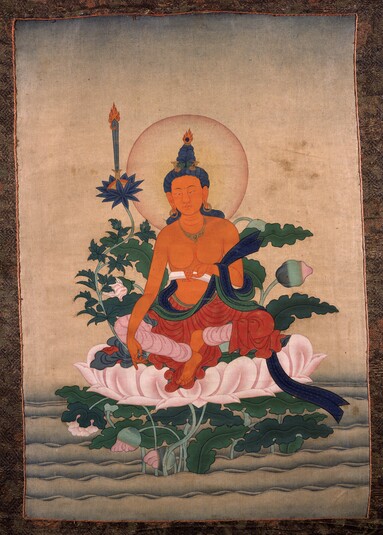
Manjushri-ghosha (Tibetan: jam pal yang. English: the Glorious One with a Melodious Voice) from the set of the 8 bodhisattva heart-sons of the Buddha Shakyamuni.
Sanskrit: Manjushri Tibetan: Jam pal yang
Peaceful and youthful in appearance, orange in colour like the rising sun, the right hand loosely extended across the knee holds the stem of a blue utpala flower blossoming above the shoulder supporting a blue upright sword of wisdom giving forth licks of flame from the tip. Cradled to the heart with the left hand is a folio text of the Prajnaparamita sutra. At the top of the head beneath a gemstone blazing with orange fire the blue hair is piled in a topknot, some falling loose across the shoulders, tied with golden flowers. A thin areola, reddish and ethereal, surrounds the head. Lightly adorned with gold earrings and a choker necklace, he wears a blue-green scarf and a lower garment with even-folds of red and pink covering the legs. In a relaxed posture of royal ease atop a large pink lotus blossom with lush green foliage rising on thin stems from a pond of blue rippling water below, he sits against an open background and vast clear sky.
"Possessing a youthful body and fully extending wisdoms lamp, you clear away the darkness of the three worlds; to you, Manjushri, I bow." (Sakya liturgical verse).
The bodhisattva of wisdom, Manjushri, first arises from the Sutrayana and secondly is a tutelary deity of the Vajrayana tradition. He is represented in all 4 tantra classes by a variety of forms, singular, complex mandalas and wrathful in appearance. The mandala of Dharmadhatu Vagishvara presents a broad display of appearances - peaceful and wrathful. From the same set see the bodhisattvas Vajrapani, Samantabhadra and Akashagarbha.
Jeff Watt 9-99
Exhibition: Wutaishan, Pilgrimage to Five Peak Mountain
Publications
Definition: Bodhisattva Religious Definition
Publication: Worlds of Transformation
Bibliography: Manjushri & Wutaishan Mountain
Thematic Sets
Buddhist Deity: Manjushri (Non-iconic Forms)
Painting Set: Eight Great Bodhisattvas (Konchog Pende/Palpung Copy)
Collection of Rubin Museum of Art: Painting Gallery 3
Buddhist Deity: Manjushri Main Page
Buddhist Figure: Bodhisattva Sculptural Forms (Non-iconic)
Iconography: Peaceful Appearance
Subject: Comparison HAR #587 & #36440
Painting Style: Kham Region (Kham-ri)
Subject: Astrological Iconography
Collection of RMA: Manjushri Masterworks
Collection of Rubin Museum of Art: Manjushri