
Item: Yogambara (Buddhist Deity) - (Three Faces, Six Arms)
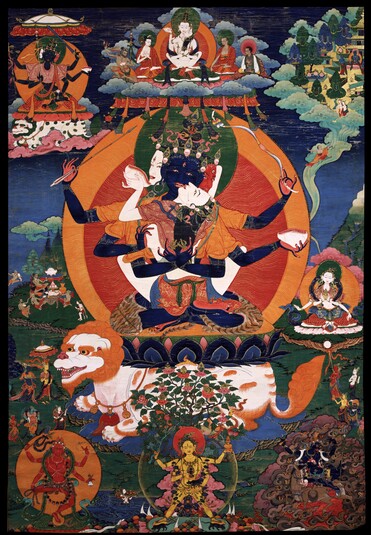
| Origin Location | Tibet |
|---|---|
| Date Range | 1600 - 1699 |
| Lineages | Uncertain |
| Material | Ground Mineral Pigment on Cotton |
| Collection | Rubin Museum of Art |
| Catalogue # | acc.#C2001.1.2 |
| Painting School | Khyenri |
Yogambara (Tibetan: nam khai nal jor), a meditational deity belonging to the Wisdom-mother classification of Anuttarayoga Tantra, made famous in the Vajravali text, a compendium of Tantric practices, of the Indian Pandita Abhayakaragupta, and also through the tradition of Marpa and Ngog Lotsawa.
Video: HAR #65002
"Yogambara, black [in colour], with three faces, black, white and red, and three eyes [each]. With six arms the first two [hands] hold a vajra and bell while embracing the mother. The remaining right [hands] caress the breast of the consort and hold an arrow. The left [hands] hold a skullcup and bowl. A jewel, crescent moon and vishvavajra adorn the black hair as an ornament, with a garland of five skulls and the Five Buddhas as a crown, having the six mudras, wearing a tiger skin [tied] loosely behind. Seated in the sattva posture [sattvasana], in the lap is the mother Jnana Dakini, white, with one face and two hands. The right hand holds a katvanga staff and the left a skullcup - embracing the father. Adorned with the five mudras." (bod brgyud nang bstan lha tshogs chen mo bshugs so, page 387-388).

Semi-wrathful in appearance, dark blue in colour, he has three faces, blue, white and red. The main pair of hands holds a vajra and bell in a gesture of embrace. The second right caresses the breast of the consort Jnana Dakini. The third holds aloft an arrow. The second left holds a white skullcup and the third upraised a bow. Seated in the relaxed Buddhist lotus posture atop a sun disc, lotus and a lion (white snow lion), he is surrounded by a red-orange nimbus and a dark green aureole beneath an ornate canopy decorated with streamers.
At the top center is Vajrasattva, peaceful, white, holding a vajra and bell embracing the consort Vajra Garvi. Surrounded by four figures, Nagarjuna, Krishnapada, a monk and a layman, they sit atop lotus seats and billowing blue clouds.
At the upper left side is the solitary form of Jnana Dakini with three faces and six hands. At the proper left side of the composition is the heavenly realm of Akshobhya Buddha known as the Abhirati pureland. Slightly below a monk flies upward on a trail of cloud ascending to the heavenly realm.
At the middle left a group of tantric yogis enjoy a ritual feast. At the right a white goddess with one face and four hands holds a vase to the heart with the first pair and performs mudras (gestures) with the second.
At the bottom left a red goddess with four hands dances atop a corpse and lotus seat. In the center a yellow goddess with four hands holds symbols of wealth while disgorging precious jewels onto a heap below.
At the right is Shri Devi, blue-black in colour, with one face and four hands, riding atop a brown mule in a sea of blood surrounded by billowing smoke.
The deity Yogambara arises from the Chaturpita Tantra and is typically surrounded by a 77 deity mandala. The practice was popularized in Tibet by Marpa the Translator and his student Ngog Lotsawa. (See Guhyasamaja and Kalachakra from the same set).
Jeff Watt 3-2000
In the book A History of Tibetan Painting by David Jackson, he says; "Another interesting reference to the mKhyen-ris style from the autobiography of the 5th Dalai Lama refers to the commissioning around 1670/71 of a set of tangkas depicting mandalas (dkyil thang) from the Vajravali cycle. The political ruler (sDe-pa) undertook to sponsor it. Since sMan-thang-pa had been perfectly expert in peaceful deities and mKhyen-brtse in fierce deities and mandalas, in the Great Fifth's opinion it was essential that both lineages should not die out," (pp.159-160).
Numbered List:
1. Yogambara
2. Jnana Dakini
3. Vajrasattva with Consort, Primordial Buddha
4. Nagarjuna
5. Teacher
6. Teacher
7. Teacher
8. Jnana Dakini, Meditational Deity
9. Goddess Unidentified, Meditational Deity
10. Marichi, Meditational Deity removing Obstcales
11. Kurukulla, Meditational Deity for Power
12. Shri Devi, Protector Deity


HAR: Jeff Watt - Profile
Thematic Sets
Subject: Tantric Feast (Ganachakra)
Buddhist Deity: Yogambara (Masterworks)
Glossary: Tantric Subjects (Vajrayana)
Painting Tradition: Khyenri Main Page
Collection of Rubin Museum of Art (RMA): Main Page
Exhibition: Artist-in-Residence Showcase
Buddhist Deity: Yogambara Main Page
Painting Set: Vajravali (Kyenri Style)
Collection of RMA: Best of Collection 1
Painting Style: Khyenri - Peaceful Deities & Semi Peaceful
Collection of RMA: How or Why an Object was Acquired
Collection of RMA: Painting Masterworks Page
Exhibition: Big!