
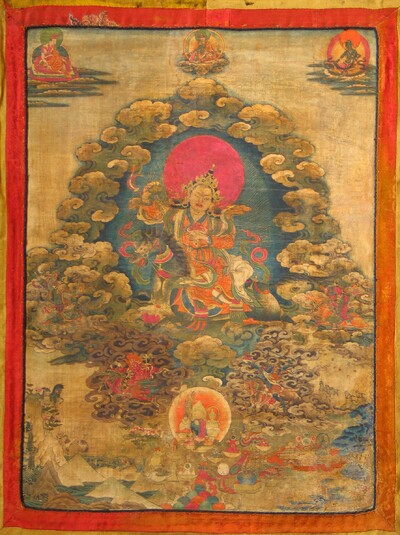
Item: Achi Chokyi Drolma - (Riding a Horse)
| Origin Location | Tibet |
|---|---|
| Date Range | 1800 - 1899 |
| Lineages | Drigung (Kagyu) |
| Material | Ground Mineral Pigment on Cotton |
| Collection | John and Berthe Ford |
Classification: Deity
Appearance: Semi-Peaceful
Gender: Female
Achi Chokyi Drolma, an historical person of the 12th century.
Born in the 11th century in Central Tibet, the Lady (achi) Chokyi Drolma was always preoccupied with spiritual practice. Believing that great things would come from her offspring and future generations she sought out and married a good man. She had four sons each of whom became a great ascetic or scholar. As a great Tantric practitioner herself and a great teacher in her own right, in a large cave before her many students, she once conducted a sacramental feast transforming a human corpse into a sacred offering. At that time she vowed to be a protector of Buddhism and composed a liturgy for invoking herself as a protector deity. Upon completion of the verses, appearing on the back of a blue horse she flew into the air and departed for a distant Buddhist heaven. Later, her great-grandson Jigten Sumgon (1143-1217), the founder of a large and influential tradition of Buddhism, Drigung Kagyu, also composed a liturgy for his famous great-grandmother and established her as a principal religious protector of the tradition.
This painting is based on those early texts and the descriptions for depicting the Lady Chokyi Drolma that now includes a large body of liturgical and commentarial literature. Atop a blue horse, she holds a double-sided drum in the upraised right hand and a skullcup in the left held to the heart; surrounded by four attendant figures each atop a horse. Two historical figures and the goddess Tara are portrayed at the top of the composition and various offerings are strewn about the foreground below the central figure.
Jeff Watt 5-2005
Inscription on the Back: Om ah hum svaha! Homage to the Victorious Kings, Holders of the Supreme Vehicle. Homage to Pema Nyingje Wangpo! [9th Situ, 1774-1853] Homage to Pema Kunzang! [10th Situ, 1854-1885]

Exhibition: Female Buddhas at RMA
Thematic Sets
Collection of John and Berthe Ford
Tradition: Drigung Kagyu Main Page
Buddhist Deity: Achi Chokyi Drolma
Subject: Female Teachers Main Page
Subject: Protectors That Are Not Wrathful
Subject: Music (Deities Related to Music)
Buddhist Protectors, Worldly Deities (Lokapala)