
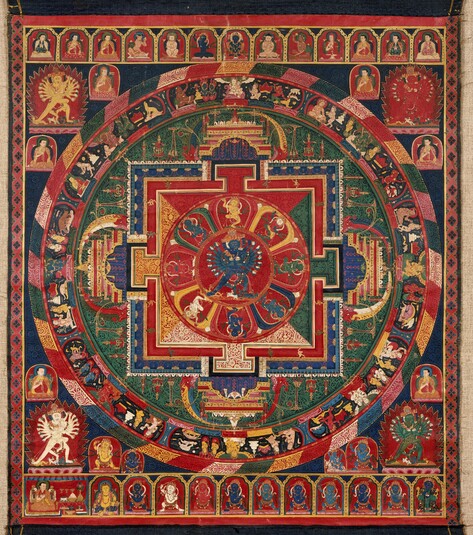
Item: Mandala of Hevajra (Buddhist Deity) - (Hevajra Tantra)
| Origin Location | Central Tibet |
|---|---|
| Date Range | 1400 - 1499 |
| Lineages | Sakya |
| Size | 63x56cm (24.80x22.05in) |
| Material | Ground Mineral Pigment on Cotton |
| Collection | Museum of Fine Arts, Boston |
| Catalogue # | acc.# 67.823, Gift of John Goelet |
Shri Hevajra Nine Deity Mandala (Tibetan: pal gye pa dor je lha gu'i khyil kor). This painting is dated by inscription to 1461 (Nepal Samvat 581). (See a quick reference chart for understanding the visual and geometric elements of the Hevajra Mandala).
Sanskrit: Hevajra Tibetan: Gye pa dor je
Within the center of the two dimensional circular diagram (mandala) representing the top view of a three dimensional celestial palace and surroundings is the deity Shri Hevajra, dark blue in colour, with eight faces and sixteen hands holding skullcups, standing with four legs in a dancing posture. The first pair of hands embrace the consort Vajra Nairatmya (Selfless One), blue, with one face and two hands holding a curved knife and skullcup, standing on the left leg with the right embracing Hevajra. They are both adorned with bone ornaments and stand atop four corpses within the flames of pristine awareness.
Surrounding the two central figures are eight goddesses of various colours, each with one face and two hands, standing in a dancing posture on the left leg above a corpse seat. Beginning at the top and placed in a clockwise direction is yellow Vetali, multi-coloured Dombini, green Ghasmari, blue Pukkasi, black Gauri, white Shavari, red Chauri, and purple Chandali. They are adorned with various ornaments and each hold their own distinct hand objects.
The floor of the celestial palace is divided into four colours ornately patterned with floral designs: red, blue, white and yellow. On the red veranda outside of the palace walls (barely discernible), on each side of the four doors ('T' shaped), are two dancing offering goddesses, sixteen in total. The outer red and white lines forming a square enclosure represent the stylized decorative facade on the four sides of the palace roof; adorned with upright spears, arrows and banners. The elaborate lintels above each of the four doors are constructed of tiered steps topped with a Dharma wheel, two reclining deer, and gold spires with a silk canopy above.
Surrounding the palace is a circle of multi-coloured (rectangular) petals representing the enormous lotus upon which the entire palace structure rests. The outer circle, divided into eight sections, containing small figures and objects is the ring of the eight great charnel grounds filled with corpses, fires, chaityas (stupas), yogis, nagas, and wrathful worldly deities.
Eight Great Charnel Grounds: according to Tantric literature and the descriptions of wrathful deities and their environments, the eight charnel grounds surround the central palace and deity. There are several different sets of eight names and descriptions for the eight great charnel grounds depending on the Buddhist and Hindu Tantric literature consulted. These charnel grounds also have physical locations in India such as the Laughing charnel ground at Bodhgaya and the Cool Grove charnel ground close by, along with the Frightening charnel ground in the Black Hills of Bihar.
From the Hevajra Tantra literature: "In the east is the Gruesome charnel ground (chandograkatasi); south Frightful with Skulls (bhairavakapalika); west Adorned with a Blazing Garland (jvalamalalankara); north Dense Jungle (girigahvaronnati); north-east Fiercely Resounding (ugropanyasa); south-east Forest of the Lord (ishvaravana); south-west Dark and Terrible (bhairavandhakara); north-west Resounding with the Cries Kili Kili (Kilikilaghoshanadita). Furthermore, there are headless corpses, hanging corpses, lying corpses, stake-impaled corpses, heads, skeletons, jackals, crows, owls, vultures, and zombies making the sound, "phaim". There are also siddha with clear understanding, yaksha, raksha, preta, flesh eaters, lunatics, bhairava, daka, dakini, ponds, fires, stupa, and sadhaka. All of these fill the charnel grounds." (Konchog Lhundrub 1497-1557, written in 1551).
The final ring is composed of the multi-coloured fires of pristine awareness completely enveloping the entire Hevajra Mandala.
Along the top are the lineage gurus for this particular mandala of Shri Hevajra. Starting from the middle and alternating to each side are the primordial buddha Vajradhara, Nairatmya, Virupa, Krishnapa, Damarupa, Avadhutipa, Gayadhara, Drogmi Lotsawa (992-1072), Seton Kunrig (1025-1113), Shangton Chobar (1053-1136), Sachen Kunga Nyingpo (1092-1158), Sonam Tsemo (1142-1182) and Dragpa Gyaltsen (1147-1216).
On the outside of the mandala circle starting at the upper left is yellow Ratnasambhava-Hevajra. On the right is red Amitabha-Hevajra. At the Bottom left is white Vairochana-Hevajra and on the right green Amoghasiddhi-Hevajra. Each of these is in the same general appearance as the central deity.
Shri Hevajra is a meditational deity of the Anuttarayoga Non-dual classification. From the many Hevajra Tantras and forms of the deity, this representation of Hevajra arises from the root Hevajra Tantra of 'two sections' and was popularized by the Indian mahasiddha (the one of great accomplishment) Virupa. The style of the painting is from Ngor Monastery in south western Tibet evidenced by the strong use of red colours and the intricate circular floral patterns used for the background and flame designs.
Mapping a Mandala: Reading a mandala is often very difficult without insider knowledge and the benefit of the explanatory literature. Painted mandala compositions are generally read from the center out and then all of the figures immediately outside of the mandala circle, followed by the top register, and then finishing with the bottom register. The important sections of the MFA Hevajra painting have been divided into colours; blue for the essential deities, red for the Eight Great Charnal Grounds, yellow for the lineage teachers and green for the miscellaneous deities added by the donor or artist.
Jeff Watt 4-2001
Numbered & Coloured Image List:
Blue - Deities:
1. Hevajra & Nairatmya
--- [The Eight Goddesses] ---
2. East - Gauri (black)
3. South - Chauri (red)
4. West - Vetali (yellow)
5. North - Ghashmari (green)
6. North-east - Pukkashi (blue)
7. South-east - Shavari (white)
8. South-west - Chandali (purple)
9. North-west - Dombini (multi-coloured)
--- [The Five Hevajras of the Five Buddha Families] ---
10. Vairochana Hevajra
11. Ratnasambhava Hevajra
12. Amitabha Hevajra
13. Amoghasiddhi Hevajra
--- [The Great Wrathful Ones] ---
14. Ushnisha Chakravartin (yellow)
15. Yamantaka (blue)
16. Humkara (blue)
17. Prajnantaka (white)
18. Padmantaka (red)
19. Vighnantaka (blue)
20. Achala (blue)
21. Takkiraja (blue)
22. Niladanda (Blue)
23. Mahabala (blue)
24. Shumbharaja (blue)
Red - Cemeteries (Charnal Grounds):
1. East - Gruesome charnal ground (Chandograkatasi)
2. South - Frightful with Skulls (Bhairavakapalika)
3. West - Adorned with a Blazing Garland (Jvalamalalankara)
4. North - Dense Jungle (Girigahvaronnati)
5. North-east - Fiercely Resounding (Ugropanyasa)
6. South-east - Forest of the Lord (Ishvaravana)
7. South-west - Dark and Terrible (Bhairavandhakara)
8. North-west - Resounding with the Cries Kili Kili (Kilikilaghoshanadita)
Yellow - Lineage of Teachers:
1. Vajradhara
2. Nairatmya
3. Virupa
4. Kanha
5. Damarupa
6. Avadhutipa
7. Gayadhara
8. Drogmi Lotsawa
9. Seton Kunrig
10. Shangton Chobar
11. Sachen Kunga Nyingpo
12. Sonam Tsemo
13. Dragpa Gyaltsen
14. Sakya Pandita
15. Chogyal Pagpa
16. Konchog Pal
17. Sonam Pal
18. Sonam Gyaltsen
19. Palden Tsultrim
Green - Miscellaneous Deities:
1. Panjarnata Mahakala
2. Shri Devi
3. Yellow Jambhala
4. Legden Mahakala


Subject: Masterworks Main Page (大师之作主页, ཕུལ་བྱུང་གི་སྒྱུ་རྩལ་ཁག།)
Thematic Sets
Collection of Museum of Fine Arts, Boston
Buddhist Deity: Hevajra Main Page
Mandalas: Sakya Tradition
Buddhist Deity: Hevajra Mandalas
Subject: Greyscale - Figurative & General Composition
Subject: Lineage Paintings - Alternating
Subject: Art History Number Sets
Collection of Museum of Fine Arts, Boston (Masterworks)
Collection of Museum of Fine Arts, Boston: Mandala Paintings
Subject: Five Buddhas (Mandala)
Mandala: Sakya Masterworks
Buddhist Deity: Hevajra & Ten Wrathful Ones
Buddhist Deity: Hevajra Iconography
Buddhist Deity: Hevajra Mandala (Masterworks)
Mandala: Mandala Main Page
Tradition: Sakya Deity Paintings