
Item: Mahakala (Buddhist Protector)
| Origin Location | Nepal |
|---|---|
| Date Range | 1960 - |
| Lineages | Kagyu, Karma (Kagyu) and Buddhist |
| Material | Ground Mineral Pigment |
| Collection | Private |
Classification: Deity
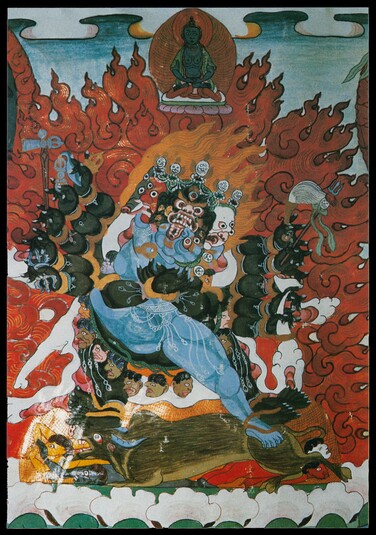
"Mahakala, four faces and twelve arms.
The Glorious Sovereign Tantra of Mahākāla, Chapter 7. From the 84000 Translating the Words of the Buddha.
The Twelve-Armed Form 7.6 “First, light radiating out from the syllable hūṁ invites the deities, gurus, buddhas, and bodhisattvas present in the threefold world. Reciting the mantra oṁ śūnyatā…, one should meditate on the fact that the entire world lacks inherent nature. The invited beings are then drawn back in along with the light radiating from the seed syllable hūṁ. After that, one should visualize the vajra enclosure.
7.7 “The yogin should continuously visualize70 the following. The deity has four faces: his main face is black, his right face is red, his left face is white, and the face behind is that of a boar. He has four legs and stands with his left legs forward. His body is black and his belly hangs down. Each face has three eyes, hair that flows upward, and a fiery beard. The rest is as stated before.
7.8 “He has twelve arms. The first pair of arms embrace the goddess as the Blessed One bites down on the goddess’ lip with his fangs. The second hand on the left holds a white fly whisk, the third holds a trident, the fourth holds a skull bowl, the fifth holds an elephant hide, and the sixth holds one of Vināyaka’s tusks. The second hand on the right holds a hooked knife, the third holds a single-pronged vajra, the fourth holds a hammer, the fifth holds an elephant hide, and the sixth hand holds a vajra.
7.9 “He rides a buffalo and tramples all māras. He stands there in sexual union with his tongue lolling and dripping with blood. The rest is as stated before.
7.10 “He is surrounded by four yoginīs who present him with songs, offerings, and gifts as he proclaims the great syllable phaṭ.71 The deity lets forth a continual stream of laughter accompanied by the syllables kili kili that expresses the nature of supreme joy. He possesses the garland mantra hili kili, which indicates he is the lord of the stages of great joy for beings so that he may bring peace to the world, and that he follows the Buddha’s teaching. [F.52.a]"
Subject: Fifty Chapter Mahakala Tantra
Collection: Private 1