| |
 |
Tibet
and the 14 Dalai Lamas
The 14 men who have borne the title of Dalai Lama since
1391 are the unifying theme of the exhibition. The individual
Dalai Lamas are depicted in paintings and sculptures. Historical
documents, films and photographs offer an exceptional image
of these leaders. A great number of the objects stem from
private collections which have seldom or never been shown
to the public before.
Date: through 6 May 2007
Venue:Wereldmuseum in Rotterdam,
Holland
|
|
 |
Goddess:
Divine Energy
The first major exhibition in Australia to explore the many
manifestations of the divine female in Hindu and Buddhist
art. Over 150 exquisitely carved sculptures and delicately
composed paintings from India, Tibet and Nepal, dating from
about 2000 BCE through to the 20th century, have been gathered
from collections around the world for display.
Opens:October 13, 2006 - January
07, 2007
Venue:Art Gallery
of New South Wales,
Art Gallery Road, The Domain,
Sydney NSW 2000, Australia
|
|
 |
TIBET – Monasteries
open their treasuries
Ancient works of religious art from the treasure houses
of Tibetan monasteries, palaces and museums (some dating
back as far as 1,500 years) are on exhibition at the Villa
Hügel in Essen, and most of these priceless objects
have never before left the "Roof of the World," making this
a unique cultural opportunity. Around 150 exhibits – sculptures,
scroll paintings, various forms of mandalas, ritual objects
and temple decorations – provide a palpable impression
of the variety of artistic styles in Tibet. The Deutsch
version and Press
Photos.
Opens:August 19 - November 26,
2006
Venue:Villa
Hügel, Essen, Germany
|
|
 |
Master
Tangka Painter Samten Dakpa
An exhibit of some 30 spectacular tangka paintings by virtuoso
Tibetan artist, sculptor, architect and teacher Samten Dakpa.
Opens:August 17 - November 10,
2006
Venue:Tibet House, New York |
|
 |
Demonic
Divine in Himalayan Art
Central to Himalayan religious beliefs is human transformation
from negativity – nourished by ignorance, egotism and
other personal demons – to spiritual liberation. Demonic
Divine explores the ferocious deities believed to aid
us in that journey, with over 50 works of art that span 600
years in one of Asia’s most remote cultural enclaves. Tibetan-style
hanging scrolls, an illuminated manuscript, ritual bronze
sculptures and carved masks represent beings that have a
protective and beneficent role in Tibetan Buddhism, as well
as the region’s native religion called Bon. Their
dramatic color and writhing forms distinguish this region’s
religious art from the quiet elegance of Chinese and Japanese
art. Organized by the Rubin Museum of Art, New York,
the exhibition provides an opportunity to experience the
rich and sophisticated concepts that form the foundation
of Himalayan art.
Opens:September 23, 2006 – December
17, 2006
Venue: Phoenix
Art Museum, Phoenix, Arizona |
|
 |
HOLY
MADNESS: Portraits of Tantric Siddhas
This exhibition surveys the art and legends of some of the
most colorful characters in South Asian and Himalayan civilization,
a group of men and women called siddha, meaning those who
are spiritually accomplished. Portraits of these holy men
and women are rendered in painting, sculpture, and photographs
drawn from museum and private collections worldwide.
Opens: February 10 – September
4, 2006
Venue: Rubin Museum of Art, New
York |
|
 |
Empowered Masters: Tibetan
Wall Paintings of Mahasiddhas at Gyantse
Some of the most important Tibetan Buddhist monuments to
have survived the ravages of history are the temples and chapels
at Gyantse in Southern Tibet. In a chapel on the upper floor
of the Palkhor Tsuglagkhang there exist superb wall paintings
of the legendary eighty-four mahasiddhas - tantric adepts
who, through effort and practice, have attained perfection
and are endowed with extraordinary powers.
Opens: February 10 - May 15,
2006
Venue: Rubin Museum of Art, New
York |
|
 |
Warriors
of the Himalayas: Rediscovering the Arms and Armor of Tibet
This exhibition is the first comprehensive study of armor,
weapons, and equestrian equipment from the Tibetan plateau,
a subject that has remained virtually unexplored until now.
Many rare or previously unknown examples of helmets, body
armor, swords, horse armor, saddles, and stirrups are exhibited
and published here for the first time. Dating from the 13th
to the 19th century, these objects include some of the finest
examples of Himalayan ironwork decorated with gold and silver
and extremely rare leatherwork embellished with paint or lacquer.
Opens: April 5, 2006 –
July 2, 2006
Venue: The Metropolitan Museum
of Art, New York |

|
 |
What
is it? Himalayan Art
Himalayan art is new terrain for many people. This exhibition
is intended to serve as a guide through this exhilarating
landscape. It is organized into four sections, each addressing
one of the following basic questions about Himalayan art:
WHERE IS IT MADE?
WHY IS IT MADE?
HOW IS IT MADE?
WHAT IS GOING ON?
Opens: October 28, 2005
Venue: Rubin Museum of Art, New
York |
|
 |
The
14 Dalai Lamas
Tibetan reincarnations of Bodhisattva Avalokiteshvara
The main exhibition on the 1st floor of the Ethnographic Museum
presents the 600-year history of Tibet as personified by a
single line of some of its leading historical figures. Displayed
in a succession of rooms and smaller spaces are historic treasures
that relate to each of the 14 men who have wielded spiritual
and secular power.
Dates: August 4, 2005, through
April 30, 2006
Venue: Ethnographic Museum of
the University of Zurich,
Pelikanstrasse 40, CH-8001 Zurich, Switzerland |
|
 |
Photography
Exhibition
“His Holiness the 14th Dalai Lama – Journey to
Peace”.
The photography exhibition on the 2nd floor features the work
of Manuel Bauer, a Swiss photographer and a Tibet specialist.
Click here
to visit The Pictorial Portrait Project.
Dates: August 4, 2005 - January
8, 2006
Venue: Ethnographic Museum of
the University of Zurich,
Pelikanstrasse 40, CH-8001 Zurich, Switzerland |
|
 |
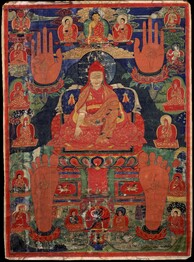
Eternal
Presence:
Handprints and Footprints in Buddhist Art
Examines the visual manifestations and devotional contexts
of handprints and footprints in Buddhist art and culture,
primarily Tibetan.
Dates: October 17, 2004 –
January 9, 2005
Venue: Katonah Museum of Art,
Route 22 at Jay Street Katonah, New York, USA
To travel:
Honolulu Academy of Art, Hawaii
February to June 2005
Rubin Museum of Art, New York City
June 4, 2005 to September 4, 2005
San Antonio Museum of Art, Texas
September to November 2005. |
|
 |
Rubin
Museum of Art
New York's newest museum, opened October 2, 2004 offers visitors
an opportunity to explore the rich artistic heritage of the
Himalayas and surrounding regions. |
| |
Female
Buddhas:
Women of Enlightenment in Himalayan Art
As an intrinsic part of life, gender identity is a powerful
tool for exploration of the divine in the visual culture of
the Himalayas. The pantheons of the major religions of the region—Buddhism,
Hinduism, and Bon—abound with Buddhas, goddesses, and
meditational deities whose divinity is framed as distinctly
feminine. Date: June 4, 2005
- January 15, 2006 Venue: 6th
Floor |
|
| |
Eternal
Presence:
Handprints and Footprints in Buddhist Art
Examines the visual manifestations and devotional contexts of
handprints and footprints in Buddhist art and culture, primarily
Tibetan. Date: June 11, 2005
- September 4, 2005 Venue:
5th Floor |
|
| |
Tibet:
Treasures from the Roof of the World
Rare treasures, borrowed from three of Tibet's foremost cultural
institutions, features woven silk and appliqué textiles,
paintings, sculpture, ritual objects, garments and books.
Date: February 19 through May 8,
2005 Venue: 5th and 6th Floors |
|
| |
Methods
of Transcendence
Imagery embodying the most profound insights of Himalayan
thought are graphically symbolized through imaginatively formed
human figures and mandalas.
Date: October 2, 2004 - January
10, 2005
Venue: 6th Floor |
|
| |
Portraits
of Transmission
The transmission of culture, art and the religions of the Himalayas
and Tibet are represented through poets, statesmen, doctors,
philosophers, religious figures and kings. Date:
October 2, 2004 - January 10, 2005 Venue:
5th Floor |
|
| |
Demonic
Divine: Himalayan Art and Beyond
These ferocious deities are often benign agents and protectors.
The exhibition probes this paradox in Himalayan art: how compassion
can often take on a fierce form. Date:
October 2, 2004 - Spring 2005 Venue:
4th Floor |
|
| |
Perfected
Beings, Pure Realms
A variety of idealized human forms set in lush landscaped surroundings
filled with flowers, light, and opulence symbolize the human
aspiration for abundance and well-being. Date:
October 2, 2004 - Spring 2005 Venue:
3rd Floor |
|
| |
Sacred
History: Portraits and Stories
Drawn from times before history, the art of the Himalayas is
based on sacred traditions of the Buddhist, Bon and Hindu religions.
These are made manifest as idealized portraits and stories of
founders and their followers. Date:
October 2, 2004 - Spring 2005 Venue:
2nd Floor |
|
|
 |
Salvation:
Images of the Buddhist Deity of Compassion
Explores the widespread importance of the Buddhist deity Avalokiteshvara—also
known as Guanyin, Kwanum, and Kannon—across Buddhist Asia.
Avalokiteshvara, the primary source of Buddhist salvation, was the
subject of extraordinary works of devotional art in various forms
across many cultures. Spanning 1,500 years, these works represent
the finest creative achievements of India, Central Asia, China,
Korea, Japan, and Tibet.
Dates: August 14, 2003 – July
5, 2004
Venue: Los Angeles County Museum of Art, 5905 Wilshire Boulevard,
Los Angeles, California, USA |
 |
Seeing
Lhasa
Rare photos, early film & previously unseen paintings reveal British
perceptions of a pre-Cultural Revolution Tibet. Dates:
September 7, 2003 - November 2004 Venue:
Pitt Rivers Museum, South Parks Road, Oxford OX1 3PP, UK |
 |
 |
Tibet:
Treasures from the Roof of the World
More than 200 examples—all with close associations with the
Dalai Lamas and Tibetan nobility—demonstrate the amazing sophistication
of art created for the most important leaders of this great world
culture.
Dates: October 12, 2003 - May
16 2004
Venue: The Bowers Museum of Cultural
Art, 2002 North Main Street, Santa Ana, California, USA
To travel:
The Houston Museum of Natural Science in Houston, Texas
October 16, 2004 - January 8, 2005
The Rubin Museum of Art in New York City
February 8, 2005 - May 8, 2005
Asian Art Museum of San Francisco
June 12, 2005 - September 11, 2005
Other cities may be added to the tour. |
 |
 |
Himalayas:
An Aesthetic Adventure
Based on an exhibition first seen at the Art Institute of Chicago—features
163 Buddhist, Hindu and Bon paintings and sculptures created between
the 7th and the 19th centuries. Dates:
October 18, 2003 - January 11, 2004 Venue:
Arthur M. Sackler Gallery, Smithsonian Institution, Washington, D.C.,
USA |
 |
 |
Masterworks
of Newar Art
Features some of the finest Nepalese Buddhist paintings of the 20th
century from the collection of Robert Beer. Dates:
November 21, 2003 - March 2004 Venue:
Tibet House, 22 West 15th Street New York, New York, USA |
 |
 |
Guardians
of the Laws: Chinese Luohan Paintings
Originating in India, the concept of "Luohan"—enlightened
beings exempted by the great Buddha from the cycle of rebirth in order
to act as guardians of the law—became a part of Buddhist cultic
worship in China, where a small number of monks who were considered
to have realized enlightenment, were selected to be luohans.
Arranged in chronological order, this exhibition presents 22, late
12th to 18th century works as well as an 8th century T'ang ewer and
describes major trends in the evolution of luohan paintings as executed
by both regional or court professionals and followers of literati
traditions. The exhibition also includes a discussion of current scholarship
about the Eighteen Luohans. Four related album leaves and three works
of calligraphy are on view in the adjacent East Corridor.
Dates: December 2, 2003 — May 23,
2004 Venue: Freer Gallery of
Art, Smithsonian Institution,
Washington D.C., U.S.A. |
 |
 |
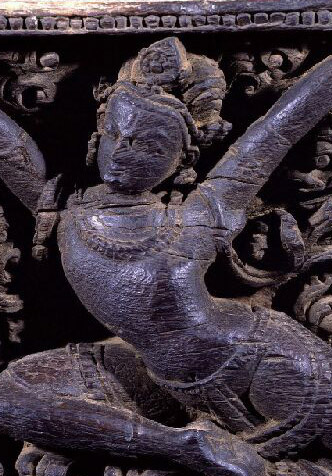
The
Flying Mystics of Tibetan Buddhism
This truly unique exhibition features Tibetan art which depicts the
literary and oral legacy of levitation and flight among Tibetan mystics.
Dates: January 25, 2004 - August
8, 2004 Venue: Oglethorpe University
Museum of Art
4484 Peachtree Road, N.E. , Atlanta, Georgia, USA |
 |
 |
The
Circle of Bliss: Buddhist Meditational Art
Showcases 150 masterworks from public and private collections from
around the world, including 40 museums. Dates:
Feb 6, 2004 – May 9, 2004 Venue:
Columbus Museum of Art, The Ohio State University, 304 Mershon Auditorium,
1871 North High Street, Columbus, Ohio, USA |
 |
 |
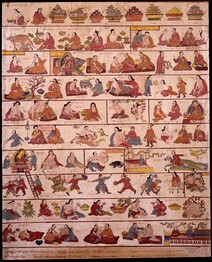
Visual
Prayers
Sacred Tibetan Buddhist Tangka Paintings Dates:
February 26, 2004 - April 3, 2004 Venue:
St. Lawrence University, Canton, New York, USA |
 |
 |
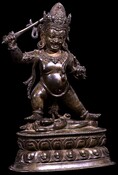
A Wrathful Deity
Examines the ferocious appearance of the great wrathful and semi-wrathful
deities, their symbolic gestures and implements, displaying their
power to tame destructive forces. Dates:
March 22, 2004 – August 22, 2004 Venue:
Asia Society and Museum, 725 Park Avenue at 70th Street New York,
New York, USA |
 |
 |
Works
of Siberian Sculptor Dashi Namdakov
Unique and exotic sculptures of horsemen, warriors, shamans and Buddhist
lamas reflecting ancient Siberian and Central Asian cultures -- but
with traces of Indian, Iranian, African and American influences.
Dates: Opening in April 2004
Venue: TIBET HOUSE U.S. 22 West
15th Street New York, New York, USA |
 |
 |
Paradise and Plumage:
Chinese Connections in Tibetan Arhat Painting.
Beginning in the 14th century, there were regular exchanges between
China and Tibet of painting traditions and motifs. The exhibit illustrates
this artistic interchange by juxtaposing paintings and objects from
China and Tibet of the fourteenth through eighteenth century.
Dates: September, 2004 - December, 2004
Venue: The Tang Teaching Museum and
Art Gallery, at Skidmore College, Saratoga Springs, NY
To travel:
The Rubin Museum of Art
150 West 17th Street, New York, New York, USA
January 2005 |
 |
Copyright © 2010 Shelley and Donald Rubin Foundation.
|