
Item: Mandala of Shambhala (Buddhist Pureland)
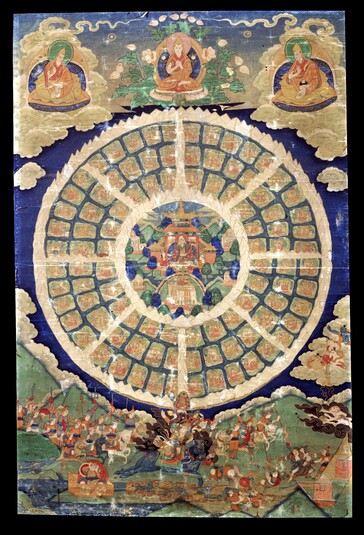
| Origin Location | Tibet |
|---|---|
| Date Range | 1800 - 1899 |
| Lineages | Gelug |
| Size | 59.69x39.37cm (23.50x15.50in) |
| Material | Ground Mineral Pigment, Fine Gold Line on Cotton |
| Collection | Rubin Museum of Art |
| Catalogue # | acc.# F1997.38.2 |
Classification: Location
Shambhala: hidden kingdom of the north, Buddhist pureland, realm of the Kulika Kings - guardians of the Kalachakra cycle of Tantras.
Shaped like a white eight petalled lotus surrounded by impenetrable snow mountains, in the center on a raised plateau, is the capital city of Kalapa. In the middle sits King Manjukirti, emanation of Manjushri, lineal descendant of King Suchandra who received the Shri Kalachakra tantra and initiation directly from the buddha Shakyamuni. Attended by wives and courtiers he dwells in an ornate palace surrounded by green hills, pavilions and pleasure gardens. Immediately in front atop a double vajra is the temple of the Kalachakra mandala wreathed by a dome of wisdom fire. A circle of white snow mountains ring the capital city. The outer area is divided into eight regions radiating like the petals of a lotus. The regions, divided by rivers and snow mountains, each contain twelve districts making a total of ninety-six in all.
At the top center is lama Tsongkapa (1357-1419) with the hands in the teaching mudra holding the stems of two lotus blossoms supporting a sword and book, attired in the robes of a monk and wearing a yellow pandita hat. At the left and right are the two main students, Gyaltsap Dharma Rinchen (1364-1432) and Kedrup Geleg Pal Zangpo (1385-1438). Both wear monastic robes and yellow hats. Each hold a book and bowl respectively in the left hand while the right hands perform the mudras of the explication of the teachings.
At the bottom, several hundred years in the future, a great battle depicts the struggle between good and evil. The armies of Shambhala acting in response to aggression, led by the 25th King Rudra Chakra, attack the barbarians of the South, assisted by worldly gods who combat the forces of daemonic darkness. Upon victory a new golden age of Buddhism dawns in the world.
Jeff Watt 3-99
Publication: Worlds of Transformation
Thematic Sets
Collection of Rubin Museum of Art: Painting Gallery 3
Tradition: Gelug Mandalas
Mandalas: Gelug Tradition
Subject: Shambhala Main Page (Sacred Geography)
Subject: Five Major Sacred Places (Tibetan System)
Subject: Shambhala Battle & King Rudracharin
Subject: Buddhafields & Purelands
Subject: Sacred Geography Main Page
Collection of Rubin Museum of Art: Mandala