
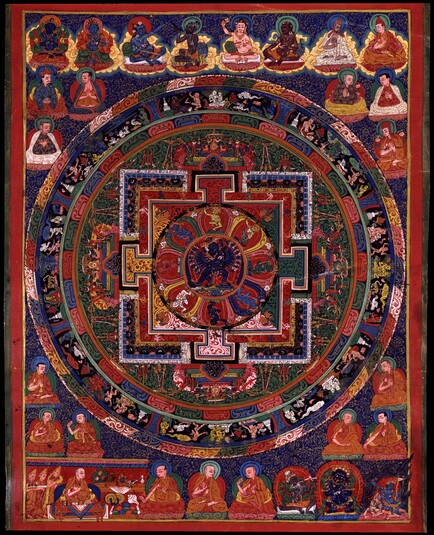
Item: Mandala of Hevajra (Buddhist Deity) - (Hevajra Tantra)
| Origin Location | Tibet |
|---|---|
| Date Range | 1500 - 1599 |
| Lineages | Sakya and Buddhist |
| Material | Ground Mineral Pigment on Cotton |
| Collection | Rubin Museum of Art |
| Painting School | Khyenri |
Shri Hevajra Nine Deity Mandala (Tibetan: pal gye pa dor jei lha gui kyil khor) according to the Lamdre system of the mahasiddha Virupa. This painting is unusual and rare because it does not follow the standard Sakya Lineage of teachers but rather diverges after the time of Lama Dampa Sonam Gyaltsen (1312-1375) and descends with Zung kyi Palwa (1306-1389) in the early Dzongpa Lineage. The later Dzongpa lineage is centered at Gongkar Chode Monastery.
Videos: - Hevajra Mandala - Acquisition Story (HAR on Patreon [9 min.]).
Bibliographic reference: Hevajra Tantraraja Nama. See an explanation of the Hevajra Mandala Elements.
Sanskrit: Hevajra Tibetan: Gye pa dor je

Within the center of the two dimensional circular diagram (mandala) representing the top view of a three dimensional celestial palace and surroundings is the deity Shri Hevajra and consort with eight attendant goddesses.
Along the top register starting at the left are the lineage of teachers beginning with Vajradhara, Nairatmya, Virupa, Kanha, Damarupa, Avadhutipa, Gayadhara, Drogmi Lotsawa, Seton Kunrig, Shangton Chobar, Sachen Kunga Nyingpo, Sonam Tsemo, Dragpa Gyaltsen, Sakya Pandita, Chogyal Pagpa, etc.
At the bottom left is a donor figure with attendants. At the bottom right are the principal protectors of the Sakya Tradition, Panjara Mahakala, Brahmarupa Mahakala and Shri Devi.
Back of Painting:
Mantra (Skt.): a series of sounds believed to embody the nature of a deity. The three doors of action are the body, voice and mind. It is through the actions of these three that good actions and bad actions are believed to be produced. Mantra recitation forms part of the daily practice of Tantric Buddhists. The most well know mantra is that of the deity Avalokiteshvara and his mantra om mani padme hum, an epithet of the deity meaning jewelled lotus. Written mantra are commonly found on the reverse of a painting placed there as a record of the painting having had a brief or lengthy sanctification blessing or ritual (Tib.: rabne). This painting of Hevajra has elaborated circles of mantra written on the back.
Numbered List:
Center: Hevajra & Nairatmya
1. Vajradhara
2. Nairatmaya
3. Virupa (837-909 approx.)
4. Kanha
5. Damarupa
6. Avadhutipa
7. Gayadhara (994-1043)
8. Drogmi Lotsawa (992-1072)
9. Seton Kunrig (1025-1113)
10. Shangton Chobar (1053-1136)
11. Sachen Kunga Nyingpo (1092-1158)
12. Sonam Tsemo (1142-1182)
13. Dragpa Gyaltsen (1147-1216)
14. Sakya Pandita (1182-1251)
15. Chogyal Pagpa (1235-1280)
16. Shang Konchog Pal (1240-1308)
17. Namza Drag Pugpa Sonam Pal(1277-1350)
18. Lama Dampa Sonam Gyaltsen (1312-1375)
19. Ngagchang Zungkyi Palwa (14th century)
20. Je Zangpo Gyaltsen (14th/15th century)
21. Je Musepa Jampa Dorje Gyaltsen, Dzong Chung (1424-1498)
22. Sempa Chenpo Zhonnu Gyalchog, Gyaltsen Konchog (14/15th century)
23. [no inscription]
- Donor Figure & attendants
24. Brahmanarupa Mahakala
25. Panjarnata Mahakala
26. Shri Devi
Jeff Watt 5-2005 [updated 8-2011]
Purchased Three Times, Returned Twice Sometimes, for museum collection history, it is important to know why an object was acquired. Sometimes it is more interesting to know how and under what circumstances an object was obtained. This small but beautiful diagrammatic painting was purchased in New York City for the Rubin collection a total of three times beginning in the late 1990s and through 2001. It was subsequently returned twice during that same time period. After the conclusion of the first purchase, based on the advice of an outside expert in the field, it was suggested that the painting was not correct, possibly a forgery, a new creation, meant to deceive for the sake of profit. It was deemed to be too clean, too perfect to be real. The painting was subsequently returned to the seller on the basis of the expert advice. However, this analysis of condition is not unusual, nor rare, nor nefarious for small format paintings to be in better condition than larger compositions. Small paintings are generally not rolled, don’t experience as much cracking or paint loss, and are not typically displayed in large butter-smoke filled temples. The colourful painting was again re-offered for purchase and inclusion in the Rubin collection. Hence, the painting was acquired for the second time. Shortly after the second acquisition of the painting another outside expert, different from the first, knowledgeable in the field and familiar with Tibetan language suggested that the inscriptions of benediction and sanctification written on the back of the composition contained misspellings and therefore the painting was suspect and possibly a forgery. Once again, based on accepted expert opinion, the painting was returned to the original seller. It is very common, if not the norm, for Tibetan paintings to have spelling errors. With the example of this diagrammatic composition there are two words omitted from a long verse written on the reverse of the painting. This kind of omission of one or several syllables or whole words is very normal and to be expected. The painting was re-offered again by the original seller in 2001 for Rubin acquisition and based on the successful removal of all questions and doubts, raised by past experts, along with a thorough analysis of the merits of the object, the painting was purchased for the final time. The object is now one of the prized possessions of the Rubin Museum of Art and an outstanding example of fine Tibetan painting of the late 15th century. (Hevajra Mandala, Sakya/Dzongpa Tradition. Tsang, Tibet, circa 1500).
Jeff Watt 12-2018


Exhibition: Mandala, The Perfect Circle (RMA)
Publications
HAR: Jeff Watt - Profile
Thematic Sets
Subject: Greyscale - Figurative & General Composition
Painting Style: Gyantse Scroll Paintings
Painting Set: Hevajra Lineage (Dzongpa)
Collection of Rubin Museum: Mandala Masterworks
Collection of RMA: Painting Masterworks Page
Collection of Rubin Museum: Mandala Masterworks (Curator's Selection)
Collection of Arnold Lieberman
Collection of Rubin Museum of Art: Mandala
Tradition: Dzongpa Main Page (Sakya)
Subject: Lineage Paintings - Linear
Collection of Rubin Museum: Mandala Masterworks (Wrathful Deities)
Buddhist Deity: Hevajra Mandala (Masterworks)
Mandala: Mandala Main Page
Buddhist Deity: Hevajra Religious Context
Collection of RMA: Historically Important Works
Tradition: Sakya Deity Paintings
Buddhist Deity: Hevajra Main Page
Collection of Rubin Museum of Art (RMA): Main Page
Mandalas: Sakya Tradition
Collection of RMA: Best of Collection 1
Buddhist Deity: Hevajra Mandalas
Buddhist Deity: Hevajra & Lamdre Lineage