
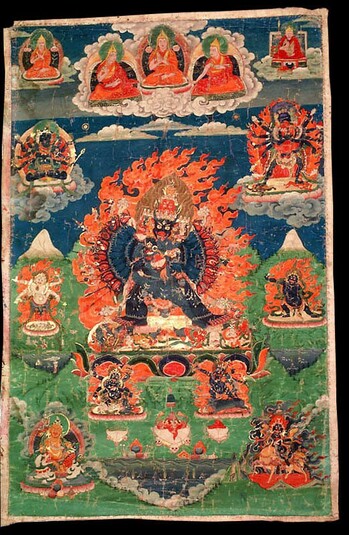
Item: Vajrabhairava (Buddhist Deity) - with consort
| Origin Location | Tibet |
|---|---|
| Date Range | 1800 - 1899 |
| Lineages | Gelug and Buddhist |
| Material | Ground Mineral Pigment on Cotton |
| Collection | Southern Alleghenies Museum of Art |
Classification: Deity
Appearance: Animal-Feature
Gender: Male
Vajrabhairava (Tibetan: dor je jig je. English: Vajra Terror): wrathful tantric form of the meditational deity Manjushri - with consort, belonging to the Anuttarayoga Tantra Classification. (See the Vajrabhairava Main Page, Outline Page and Forms of Manjushri: Context Page).
Dark blue in colour with nine faces, thirty-four hands and sixteen legs, the main face is that of a buffalo, with a red face above between the horns and the slightly angry orange face of Manjushri placed on top. With three faces to the right and three more to the left, each has three eyes and a gaping mouth. Brown hair flows upward like flames. The first pair of hands hold a curved knife and skullcup and embrace the consort Vajra Vetali, blue, with one face and two hands holding a skullcup. The thirty-two remaining hands extended out to the sides hold a variety of fierce objects. Adorned with all the wrathful ornaments, skull crowns and ornaments of bone, he stands with the right legs bent and the left straight. Both sets of feet press upon various human, animal, bird and god figures, above a sun disc and multi-coloured lotus blossom completely surrounded by the orange flames of pristine awareness. In the foreground three white skullcups brimming with offerings, wishing jewels and various precious objects are all arranged neatly.
At the top center is the Lord Tsongkapa (1357-1419) performing the teaching gesture with the hands at the heart while holding the stems of two lotus blossoms supporting a sword and book at the right and left side. Attired in monastic robes he wears a yellow pandita hat and sits in vajra posture. At the left is the elder of the two principal disciples, Gyaltsab and on the right Khedrup, both in similar appearance. At the top left is a lama appearing like Tsongkapa and holding the stems of two lotus blossoms supporting a vajra and bell. At the right is the 13th Dalai Lama (1876-1933) with the right hand performing the mudra of blessing and holding the stem of a lotus with the blossom supporting a sword and book. Cradled in the lap the left hand holds a Dharma Wheel. With a monk's staff standing upright behind the left shoulder he sits on a cushion throne rather than a lotus seat indicating the painting was likely commissioned during his lifetime.
To the lower left and right are the meditational deities Akshobhyavajra Guhyasamaja, blue, with three faces and six hands and Chakrasamvara, blue, with four faces and twelve hands. Below on the left is the wealth deity White Mahakala with one face and six hands. At the right is the wrathful bodhisattva Vajrapani, dark blue with one face and two hands.
Below the central figure of Vajrabhairava, at the left is the wrathful protector Shadbhuja Mahakala (Great Black One with Six Hands), Avalokiteshvara emanating as Mahakala, dark blue in colour, with one face and six hands. At the right is the special protector of the Vajra Bhairava Tantras, Yama Dharmaraja, dark blue, with the head of a buffalo, holding a bone stick and lasso. Embraced by the consort Chamundi he rides on the back of a buffalo. At the bottom left is the guardian of the northern direction, protector and wealth deity, Vaishravana Riding a Lion, orange in colour with one face and two hands holding a victory banner and a mongoose, riding on a snow lion. These three deities are the special protectors of the Gelugpa Tradition representing the superior, middling and inferior types of persons according to the Lamrim (Stages of the Path) literature.
At the bottom right is the female deity and special protector of the Dalai Lamas, Magzor Gyalmo, wrathful Sarasvati, black, with one face and two hands holding a stick and skullcup, riding a mule, surrounded by dark smoke and licks of red flame.
As a meditational deity Vajrabhairava (sometimes referred to by Western scholars as Yamantaka) belongs to the Yamari class of tantras and specifically arises from the Vajrabhairava Root Tantra (Tib.: jig je tsa gyu) and belongs to the method (father) classification of Anuttaryoga Tantra. The practice of Vajrabhairava is common to the three Sarma Schools: Sakya, Kagyu and Gelug. There are numerous forms and styles of practice from the very complex mandalas with numerous deities to the very concise with a single Heruka form having one face and two hands. The main lineages to enter Tibet were those of Rwa Lotsawa Dorje Drag and Mal Lotsawa.
This form of Vajrabhairava with the central faces placed three vertically and three faces at each side arranged horizontally - circular faces - is special to the Gelugpa School and true to a visionary experience of Lord Tsongkapa the founder. There are different systems and ways of depicting the nine faces.
Lineage: Shri Vajrabhairava, Jnana Dakini, Mahasiddha Lalitavajra, Amoghavajra, Yeshe Jungne Bepa, Mahasiddha Padmavajra, Marmedze Srungwa, Rwa Lotsawa Dorje Drag, Rwa Chorab, Rwa Yeshe Sengge, Rwa Bum Seng, Rongpa Gwalo Namgyal Dorje, Rongpa Sherab Sengge, Lamdrepa Yeshe Palwa, Je Sonam Lhundrup, Choje Dondrup Rinchen, Je Tsongkapa Lobzang Dragpa (1357-1419), etc.
Jeff Watt 1-99
Subject: Meditational Deity Triad (Gelug)
Collection of Southern Alleghenies Museum of Art
Tradition: Gelug Deity Paintings
Buddhist Deity: Vajrabhairava Main Page
Collection of Southern Alleghenies: Deity