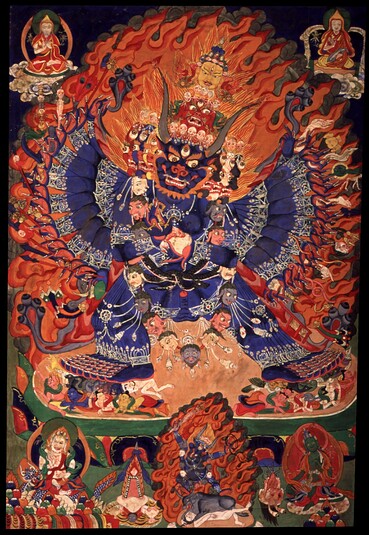
Vajrabhairava (Tibetan: dor je jig je. English: Vajra Terror): the bodhisattva Manjushri appearing as a meditational deity of the Father (method) classification of anuttarayoga tantra. At the top left is Lama Tsongkapa.
Jeff Watt 10-2000
Sadhana Description: ??Sri Vajra-mahabhairava (dpal rDo-rje? jigs-byed chen-po), dark blue, with nine faces, thirty-four arms and sixteen legs, abiding in pratyalidha posture (right legs bent). Capable of devouring the three worlds, he is shouting ?Haha? and has rolled-up tongue, bared fangs and a frown. Beside the frown, his eyebrows and eyes blaze like the fire at the time of destruction. His pale yellow hair streams upwards. Threatening the worldly and supermundane gods, he terrifies even the terrible, roaring like thunder the great sound of PHEM and eating human blood, grease, marrow and fat. He is crowned with five frightful dry skulls and adorned with a skull garland of fifty fresh heads, a black snake as scared thread, a circlet of human bone, and earrings and the other ornaments of bone. He is naked of body, with huge belly. His sex stands erect. His eyebrows, eyelashes, beard and body hairs blaze like the fire at the end of time.
His principle face is a buffalo?s, black, extremely wrathful and with sharp horns. Above this, midway between the two horns, is a red face, most frightful, with blood dripping from its mouth. Above this is the yellow face of Manjushri, just a little wrathful, adorned with the ornaments of a young man, with five locks on the crown of his head. The main face under the right horn is blue, that to its right red, and that to its left yellow. The main face under the left horn is white, that to its right smoke-colored, and that to its left black. These faces are extremely wrathful. All nine faces are three-eyed. The first pair of arms hold a fresh elephant-skin, stretched out with its head on the right and hands and feet on the left, showing the hairs outside. The remaining right hands hold 1. a knife, 2. a dart (bhindipala), 3. a wooden pestle, 4. a knife with a wavy blade, 5. a harpoon, 6. An axe, 7. a spear, 8. an arrow, 9. a hook. 10. a club, 11.a khatvanga, 12. a wheel, 13. a five-pointed vajra, 14. a vajra hammer, 15. a sword and 16.a damaru. The left hold 1. a blood-filled skull, 2. a Brahma?s head, 3. a shield, 4. a foot, 5. a noose, 6. a bow, 7. entrails, 9. a hand, 10. a shroud, 11. a man impaled on a stake, 12. a brazier, 13. a piece of a skull, 14. a threatening, forefinger, 15. a triple banderole and 16. a fan (rlun ? ras, also ?prayer-flg?). His feet tread on 1. a human being, 2. a buffalo, 3. an ox, 4. an ass, 5. a camel, 6. a dog, 7. a sheep and 8. a fox (or jackal) his left feet on 1. a vulture, 2. an owl, 3. a ravan, 4. a parrot, 5. a hawk, 6. a garuda, 7. a domestic fowl and 8. a swan. He also tramples beneath his feet Brahma, Indra, Visnu, Rudra, Six-faced Kumara (= Karttikeya), Vinyaka (Ganesa), Candra and Surya, lying face down. In this manner he abides amid an intensely blazing mass of fire.?