
Item: Teacher (Lama) - (unidentified, male, monastic)
| Origin Location | Tibet |
|---|---|
| Date Range | 1700 - 1799 |
| Lineages | Sakya, Ngor (Sakya) and Buddhist |
| Material | Ground Mineral Pigment on Cotton |
| Collection | Private |
Classification: Person
Appearance: Monastic
Gender: Male
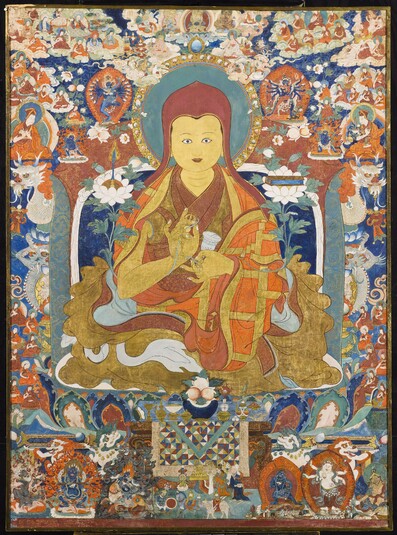
Teacher (unidentified), belonging to the Ngor branch of the Sakya Tradition with lineage teachers above and protector deities below.
At the upper left is the meditational deity Shri Hevajra. At the upper right is the meditational deity Chakrasamvara.
At the bottom left corner of the composition is Brahmanarupa Mahakala, Panjarnata Mahakala and Shri Devi Dudsolma. On the right side is Black Jambhala, White Mahakala and Yellow Jambhala.
Jeff Watt 2-2016
The large central figure is in monastic appearance wearing the robes of a fully ordained monk and wearing a red pandita hat. He holds a vajra scepter and bell at the heart in the right and left hands in the gesture of Dharma teaching. He also holds the stems of two flower Blossoms which extend to the level of the shoulders with the blossom on the right side supporting an upright sword and the blossom on left side supporting a book. Seated in cross leg posture on a moon disc and multi lotus he is wrapped in a meditation cloak. There are no inscriptions on the front of the painting so an identification cannot be made.
In the upper portion of the composition are many small figures of teachers representing the lineage of the Sakya Lamdre (Margapala) beginning with Vajradhara at the top center and alternating to the left and right sides with Vajra Nairatmya, Virupa, Kanha, Avadhutipa, and so on. These are followed the iconographically identifiable five founding teachers of Sakya. The lineage descends downwards and also along the right and left sides of the composition. Once again there are no written inscriptions for the lower figures making the identification of each more difficult.
Looking at the right and left sides of the painting on a level with the head of the central figure, there are the two meditational deities Hevajra and Chakrasamvara. Slightly below are the two forms of Vajrapani, Bhutadamara and Krodha Vajrapani, both blue in colour and wrathful in appearance.
There are two additional teachers to the right and left sides of the two Vajrapani deities. They are much larger in size compared to the lineage teachers descending from the top of the composition which indicates that they are not necessarily part of the lineage but likely belong to the period of the central teacher as important students or possibly his own teachers.
At the bottom of the composition there are three figures to the right and three to the left. On the viewer's left side at the center of the three is Panjarnata Mahakala the chief of all protectors for the Sakya Tradition of Tibetan Buddhism. To the left is Brahmanarupa Mahakala, brownish in colour, holding a bone trumpet. To the right is the female protector deity Shri Devi Dudsolma with one face and four hands riding atop a donkey.
At the bottom right side the central figure is White Mahakala with one face and six hands. To the left is Black Jambhala and to the right is Yellow Jambhala. These three figures are wealth deities and commonly included in Sakya paintings.
The painting this painting is quite large in size and likely created to commemorate the passing or the funeral services of an important abbot of Ngor Monastery in the Tsang Province of Central Tibet. This type of composition and the large format fits very well into a genre of painting popular at Ngor Monastery.
The styple of painting could best be described as a mix of Tashi Lhunpo Monastery style and Lhasa New Menri style. This is particularly noticeable with the clouds in the upper composition, the elaborate gold and jeweled halo circling the head of the principal figure along with the lack of negative space except for small patches of blue sky above and to the sides.
Jeff Watt 7-2026
Bibliography: Jörg Heimbel (University of Hamburg, Asia and Africa Institute, Abteilung Indien und Tibet, Faculty Member).
Vajradhara in Human Form: The Life and Times of Ngor chen Kun dga' bzang po by Jorg Heimbel. Mar 1, 2018.
Portraying the Lineage Masters of the Path with Its Fruit: Lowo Khenchen’s Description of Ngorchen’s Commission. Jörg Heimbel and David Jackson. 2023.
The Memorial Thangka of Drangti Penchen Namkha Pelzang, the Thirteenth Abbot of Ngor Heimbel, Jörg. 2022.
Portraits of the Great Abbots of Ngor: The Memorial or Death Anniversary Thangka (dus thang) Heimbel, Jörg. 2021.
A Dialogue Between Text and Image: Examining the Historico-Religious Context of a Narrative Thangka Painting Depicting Episodes from the Life of Shar chen Rin chen mi 'gyur rgyal mtshan (1717–1780). Heimbel, Jörg. 2020.
Tradition: Sakya, Teachers (Ngor Abbots, Large Format)
Collection: Sotheby's New York (Painting. March, 2016; Part II)
Teacher: Unidentified