
Item: Shri Devi (Buddhist Protector) - Dudsolma
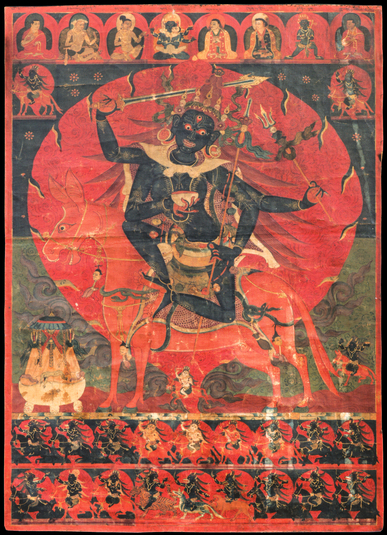
| Origin Location | Tibet |
|---|---|
| Date Range | 1300 - 1399 |
| Lineages | Buddhist |
| Material | Ground Mineral Pigment on Cotton |
| Collection | Tibet Museum – Alain Bordier Foundation, Gruyères |
Classification: Deity
Appearance: Wrathful
Gender: Female
Shri Devi (Tibetan: pal den lha mo): the principal female wisdom protector of Tantric Buddhism.
Wrathful in appearance, dark blue in colour, she has one face and four hands. The two right hands hold a white skullcup to the heart and an upraised sword. The left hold a spear and a trident held upraised. Three peacock feathers adorn the crown of the head. Seated atop a donkey wading through an ocean of blood she is surrounded by wisps of red flame and clouds of dark billowing smoke. A host of retinue figures accompany the central deity.
Jeff Watt 4-2000 [updated 4-2026]
There are a few very interesting points to discuss about this painting. Firstly, the Shri Devi that we see here is almost identical to the Shri Devi located on the lower right within an early painting of Marpa Lotsawa (#58356). We know that the Marpa painting would have been an earlier production; therefore, this painting of Shri Devi must probably be based on the Marpa painting and executed at a slightly later date.
Another very interesting detail that we see is how the necklace of freshly severed heads on Shri Devi is drawn. Within the same period (14th century), we also see this being implemented into the creation of sculptures of this form of Shri Devi, notably HAR (#16810). The style of the petite, elongated-shaped, detailed drawings of evenly spaced heads appears in many of Trengkawa’s drawings within his sketchbook, including depictions of semi-peaceful, semi-wrathful deities such as Hevajra, Mahayamaya, and others, which date from the early 16th century. This style of depicting heads had already been implemented in imperial textiles of the Yongle period (15th century), as seen in example HAR (#200753) . This stylistic feature continues in later masterwork examples of Shri Devi Dukam Wangchukma, such as HAR (#90185) . Styles often get borrowed from one painting to another, and here we see this borrowing across regions beginning right around the 14th century and continuing through the 18th centuries.
Shinzo Shiratori 2-2026
Reverse of Painting
Special Features: (Cursive script (Umay), is stupa-shaped)

Collection: Tibet Museum, Alain Bordier Foundation
Buddhist Protector: Shri Devi Iconography List
Buddhist Protector: Shri Devi Earrings
Buddhist Protector: Shri Devi, Dudsol Dokam Wangchugma
Buddhist Protector: Shri Devi (Masterworks)
Publication: Art Sacre du Tibet (Painting)
Buddhist Protector: Shri Devi (Early Works)
Publication: Buddhist Art of Tibet (Painting)