
Item: Mahakala (Buddhist Protector) - Brahmarupa (Brahmin Form)
| Origin Location | Tibet |
|---|---|
| Date Range | 1700 - 1799 |
| Lineages | Buddhist |
| Size | 80x60cm (31.50x23.62in) |
| Material | Ground Mineral Pigment, Black Background on Cotton |
| Collection | Private |
Classification: Deity
Appearance: Mahasiddha
Gender: Male
Brahmanarupa Mahakala.
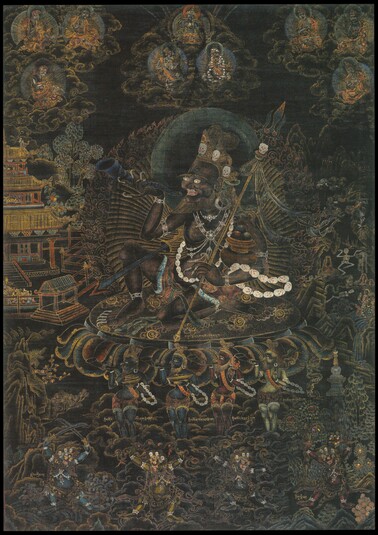
A black ground painting of Brahmanarupa Mahakala, featuring unique iconography, dated to the 18th century by a Musee Guimet publication. Appearing as an Indian brahman, he has one face and two hands, brown in colour, and rests with one leg in a kneeling posture on a sun disc on a lotus, surrounded by flames. He holds a hollow antelope horn in his right hand, and a sword is under his right arm. In his left hand he holds a trident, wears a skull mala on his left wrist and has a treasure vase filled with jewels in the crook of his left arm. He wears a silk loincloth, bone ornaments, a crown of five skulls and a dry skull necklace. On his left is a three-storey temple and on his right is a detailed charnel ground.
Directly above Brahmanarupa, top center, is Buddha Vajradhara flanked by mahasiddha Saraha on the left and Virupa on the right. At the top right and left corners are the Six Ornaments, a group of the most famous Indian Buddhist scholars. At the top left corner are Nagarjuna, Dignaga and Dharmakirti, the inscriptions are legible. The inscriptions on the right corner are illegible, but they are likely Aryadeva, Asanga, and Vasubandhu.
These mahasiddhas and the Six Ornaments as a group are unrelated to the teaching lineage of the Guhyasamaja Tantra in the Sakya tradition, which is where concept of Brahmanarupa Mahakala originates as an alternate form of Chaturmukha Mahakala from the Guhyasamaja. This likely indicates a customised design based on the preference of the compositions commissioner.
Below Brahmanarupa are four figures in the appearance of brahmins. They all have one face, two hands, but they are all different in color. They all blow into antelope horns held in their right hands, have skull malas on their left arms and wear meditation belts across their chest. The two left-most hold a large offering plate in their left hands. The left-most plate contains a tiered offering resembling a mandala plate, the center-left one contains a liquid. The two right-most perform a wrathful mudra with their left hands, the right-most one emits wind from his left hand, the center-right one emits flames from his left hand.
The inscription below the large main figure states “Brahmanarupa, who purifies pride”. Each of the smaller brahmins is labeled. from left to right: Brahmanarupa who purifies ignorance (gti mug), who purifies greed (‘dod chags), who purifies hatred (zhe sdang), who purifies jealousy (phrag dog).
Below the four standing Brahmanarupas are four wrathful female spirits, mamos. They all have one face, two hands, three eyes, but they are all different colors. They all wear skull crowns, human and tiger skins, a necklace of freshly severed heads, bone ornaments. The left-most holds two curved swords, the center-left holds flames with both hands, the center-right holds wind or clouds with both hands, and the right-most holds a sickle or razor in the right hand and a sheaf of flowers in the left hand. They are labeled from left to right: glogs phrin ma, missing inscription, glog rlung ma, glogs lcam ma. These are not the four dakinis that typically accompany Brahmanarupa in other paintings, because those four carry identical curved knives and skull cups instead and are differentiated only by colour.
This fourfold duplication of Brahmanarupa and the four wrathful female figures are unique iconography and it also appears to be related to the four elements. The Brahmanarupa who purifies greed holds a liquid offering and the mamo holding swords stands above turbulent water. The Brahmanarupa who purifies ignorance holds a solid offering and the mamo holding a sickle and flowers stands in a mountainous, forest landscape possibly symbolising earth. The Brahmanarupa who purifies hatred emits fire, and so does one of the mamos. The Brahmanarupa who purifies jealousy emits wind and so does one of the mamos.
Nick Dharmadi, 2-2026
Mahakala: Brahmanarupa Page
Mahakala: Brahmanarupa Page (Black Ground)