Publication: Handbook of Tibetan Iconometry
Sketchbook PageHandbook of Tibetan Iconometry, A Guide to the Arts of the 17th century.
Video: Handbook of Tibetan Iconometry
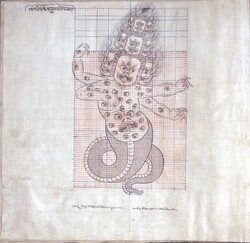
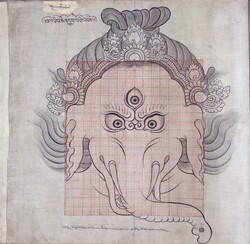
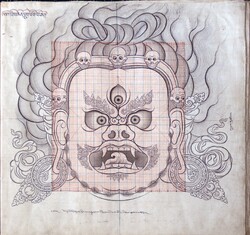
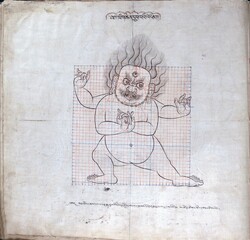
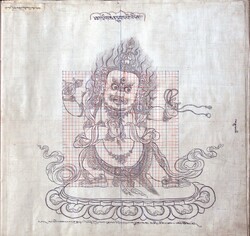
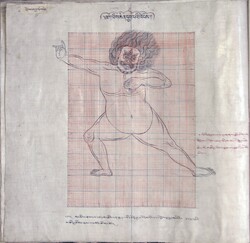
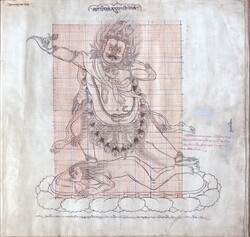
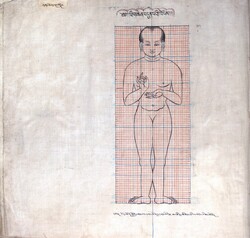
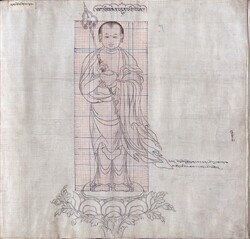
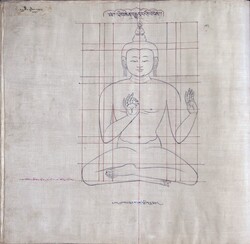
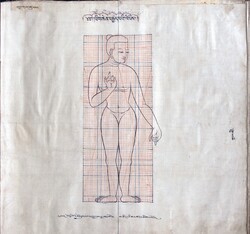
This sketchbook is part of a manuscript titled: “Illustrations of Measurements: A Refresher for the Intelligent” (cha tshad kyi dpe ris dpyod ldan yid gsos). It was commissioned by Desi Sanggye Gyatso (1653-1705) in 1687 and consists of three parts: 1) iconometric illustrations of deities, 2) samples of different Tibetan and Indian scripts such as calligraphy, and 3) iconometric measurements of stupas. These correspond to the representations of the body, speech and mind of the Buddha.
Each of the illustrations is an ink painting done with brush work on pages made of canvas. The proportions for the deities is partially based on Desi Sangye Gyatso’s Rust Colored Vaidurya (Vaidurya g.ya sel), in which the Desi devoted a section of the treatise to iconographic measurements. Nearly all of the illustrations of deities are accompanied by illustrations showing them without clothing or ornaments for other artists learning from this text to understand the physique and proportions of each figure. There are also close-up illustrations of the faces of different types of deity appearance, such as peaceful male, peaceful female, wrathful male, wrathful female, etc.
According to the afterword of the book, the artist who illustrated all the deities and stupas in the first and third sections of the book was Lhodrak Kukye Norbu Gyatso. This artist is also known as Lhodrak Tenzin Norbu, and is recorded in "A History of Tibetan Painting. The Great Tibetan Painters and their Traditions", by David Jackson. Verlag der Osterreichischen Akademie der Wissenschaften. Wien, 1996.
Several of the deities' iconography are based on less popular forms, or forms specific to the Fifth Dalai Lama's secret visions. Several generic figures which are types of deities or spirits, rather than specific deities are also represented. However they are identifiable by name in the inscriptions.
Nick Dharmadi, 3-2026