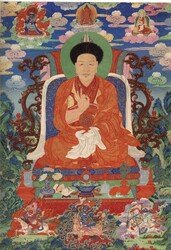
Painting: True Portraits Page
Teachers Main Page | Painting PortraitsSubjects, Topics & Types:
- Description (below)
- Outline Page
- Historical Inscriptions
True Portrait painting should be a true likeness of a living person of the past or present. Portrait faces, or true portrait faces, are not uncommon but are rather rare compared with all of the paintings and sculpture depicting religious figures. From the early days of the second millennium there have been paintings of eminent Kadam, Sakya and Kagyu teachers. The paintings characterized as Taglung style are often depictions of portraits of Pagmodrubpa, Taglung Tangpa Chenpo and Jigten Sumgon.
However, even if a portrait is painted within the lifetime of the person being depicted, the person may choose to be depicted in an idealized or generic way. In that case, we would classify that as Distinctive Faces, which are characterized by a special feature or element that can be related to a historical person or famous person from myth. Distinctive faces have standardized and recognizable features but are not necessarily true portraits.
Whether a painting is a true portrait or just a distinctive face can not always be known unless there is a supporting inscription on the back of the painting, or information about a portrait being commissioned in the biography of the person being depicted, or accompanying provenance information.
Some examples of True Portrait painting are those of Jamgon Amnyezhab, Fourth Demo Rinpoche, Terdak Lingpa Gyurme Dorje, First (4th) Panchen Lama, Third (6th) Panchen Lama, Changkya Rolpai Dorje (See examples below).
Beginning in the 20th century, with the introduction of photo-realism into Tibetan painting, it became much easier and increasingly popular to create True Portraits of important teachers.
Nick Dharmadi 10-2026