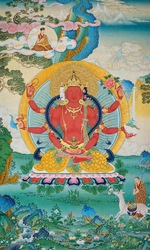
Subject: Combined Practice of the Three Roots (Tsa Sum Dril Drub)
Terma, Revealed TreasureSubjects, Topics & Types:
- Description (below)
- Four Cycles:
--- Three Roots (Sanggye Lama followed by Khyentse Wangpo)
--- Karma Kagyu (3rd Karmapa)
--- Northern Treasure (following Jamyang Lama)
--- Deathless (Choje Lingpa, Chos-rje-gling-pa)
- Confusions: Tsasum Osel Nyingtig
- Others...
The Tsasum Drildrup (Tibetan rtsa gsum dril sgrub, “Combined Practice of the Three Roots”) is a terma cycle whose title says what it does. It joins the three roots of Vajrayana practice into one practice: the guru, the yidam (meditational deity) and the dakini. The Lotsawa House translation archive says it was originally discovered as a terma by Sangye Lama (1000–1080) and later rediscovered by Jamyang Khyentse Wangpo (1820–1892). That makes it a yangter, or “re-revealed treasure”, and the Rangjung Yeshe dictionary also classes it as a yangter by Jamyang Khyentse Wangpo. That history is the cycle’s most distinctive feature. Sangye Lama is usually counted as one of the very first tertöns, so the cycle sits at the start of the terma tradition. Its re-revelation in the nineteenth century puts it in the setting of the Rimé (non-sectarian) movement, which Khyentse Wangpo led together with Jamgön Kongtrul.
In practice, the cycle gives a compact way to do guru, yidam and dakini practice in one session instead of keeping separate sadhanas for each. That compactness probably explains why it was taken up by later masters in Khyentse Wangpo’s line. For example, Jamyang Khyentse Chökyi Lodrö wrote verses for accumulating the tsok offering for it, and it still circulates in Khyentse-related lineages today. Note that the name isn’t unique to this cycle. The Karma Kagyu has its own “Three Roots Unified” practice under the same Tibetan title, and in 2025 the 17th Gyalwang Karmapa published a set of three Karma Kagyu texts online related to the Three Roots Unified practice. The Karma Kagyu version of Tsasum Drildrup is based on a pure vision of the Third Karmapa, Rangjung Dorje (1284-1339 [55 yrs]), with the three roots, consisting of Padmasambhava, Jinasagara Avalokiteshvara and Mahakala Bernagchen in one form as a three faced six armed Amitayus.
HAR Team, 11-2026