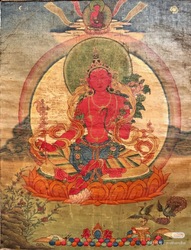
Buddhist Deity: Tara, Red Summary
Red Tara Main PageRed Tara” isn’t a single deity. It’s a group of red forms of Tara, and red signals the activity of power, attraction or “magnetising” (Sanskrit vaśya). The most common forms of Tara are the green which is considered particular for all types of activities, white for longevity and red for power. They are sorted into three categories: the Individual Tradition Red Taras, the Tara/Kurukulla and the Red Taras within the Twenty-One Taras.
The first group, which are referred to as Individual Tradition Red Taras, is a scattered set of red Taras that come down through particular texts and lineages such as Ishvara Uddiyana Tara, Chunda Tara, Nyen Lotsawa Tradition, a Sakya Tradition. There are likely to be many more traditions of Red Tara originating in the Nyingma 'Revealed Treasure' tradition of Tibetan Buddhist. A popular Nyingma example is the Red Tara of the Dzigar Terton tradition. Several of these forms of Tara were collected in large iconographic compendia, the Rinjung Lhantab (with an Ishvara Tara from Oddiyana) and the Drubtab Gyatso, which have red-green Taras with two or four arms. A popular 20th century Tara was revealed by the Nyingma terton Apong Terton (1895–1945). Tradition holds that Apong Terton next incarnated as His Holiness Sakya Trizin (born 1945), which ties the practice to the Sakya throne holder. Chagdud Tulku made this practice widely known in the West.
The second group is where the two female deities Red Tara and Kurukulla overlap. Kurukulla is a red goddess of attraction with a bow and arrow made of flowers. She comes from the Indian tantras, most importantly the Hevajra Tantra, and the Sakyas count her among their “Three Great Red Deities,” together with red Ganapati and Takkiraja. In Tibetan thought she is treated as a form of Tara, so HAR has a “Tara-Kurukulla” category, including a five-deity mandala and a second Nyen Lotsawa tradition. Paintings of her are easily confused with other red deities such as Red Sarasvati and Red Lokeshvara as figures often mistaken for her.
The third group and probably the best-known red Taras come from the Twenty-One Taras, which derive from the Twenty-One Praises of Tara, a text that comes down in several lineages: Pandita Suryagupta, Lord Atisha and the Sadhanasamucchaya. The Atisha lineage, brought from India in the 11th century, is the one most often in Himalayan art paintings. It places a red Tara first, and that is the principal Tara of the Atisha Tradition of the Twenty-one Taras. She is Drölma Marmo, “Very Heroic” Red Tara, and her function is power. Unusually, Green Tara is not included in the enumeration of the Twenty-one Taras of Atisha. There are four red Taras, six white, three yellow, four orange, two maroon (red-black) and two black Taras for a total of 21. The red-black (maroon) forms, such as Tara Defeating Enemies and Daemons, lean toward wrathful activity. The Suryagupta system, probably the oldest, has its own red figures with different iconography. The precise number of Tara forms that are red in colour will often be different between the commentarial literature and the artists own tradition of painting and iconography.
In summary, there are three strands. The Individual Tradition forms survived in compendia and family or school lineages. The Kurukulla-related forms, from tantra and later Nyingma revelation, are where Red Tara’s power over attraction is developed most fully. The 21-Tara Red Taras come from Indian praise literature that Atisha systematised in the 11th century.
HAR Team, 11-2026
(The images below are only a selection of examples from the links above).