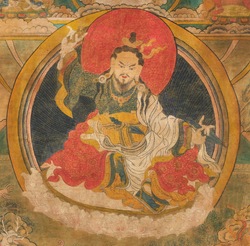
Teacher: Dudjom Lingpa Texts Teachings
Dudjom Lingpa PageDudjom Lingpa Texts & Teachings
Dudjom Lingpa (1835–1904) was a lay tertön (treasure revealer) from Golok in eastern Tibet. He is known for visionary “mind treasures,” mostly on Dzogchen, and for the Dudjom Tersar (“New Treasures of Dudjom”) lineage that his reincarnation, Dudjom Rinpoche Jigdral Yeshe Dorje, later expanded. Most sources give his death as 1904 rather than 1903, though some say 1903.
Dudjom Lingpa was born in the Ser valley of Golok. He had little formal education and was never a monastic scholar. His autobiography describes visions of Padmasambhava, Yeshe Tsogyal, ḍākinīs and other figures from early childhood, and these visions became the source of his teaching. He lived as a lay yogi with a family and many children. Several of his sons became important lamas: Jigme Tenpe Nyima, the third Dodrupchen, was a major scholar, and Tulku Drimé Özer was the consort of the female tertön Sera Khandro.
He founded no large monastery. His influence spread through disciples practising in encampments and retreat, and tradition says many of them attained the rainbow body. A figure of thirteen is commonly given. His revelations fill around twenty volumes. They are mostly “mind treasures” (gongter) and “pure visions” (dagnang), meaning teachings that arose in his mind or in visions rather than being dug up as physical objects. The best-known works are:
Buddhahood Without Meditation (Nangjang, “Refining Apparent Phenomena”): a visionary dialogue in which deities and teachers instruct him. It moves from analysis of the self and phenomena, to recognizing awareness, to trekchö, and finally to tögal.
The Vajra Essence (often called the Neluk Rangjung, “Self-Arising Natural State”): a long visionary tantra in dialogue form. A teacher (Samantabhadra, appearing as the Lake-Born Vajra, Padmasambhava) answers questions from a circle of bodhisattvas, each named after a quality such as “Faculty of Insight.” It covers the whole path, from shamatha to the final result.
The Sharp Vajra of Conscious Awareness Tantra: a shorter Dzogchen tantra on the same themes as above, along with other various short Dzogchen instructions and songs of advice.
Practice Cycles:
Tröma Nagmo (the Black Wrathful Mother): a Chöd cycle centred on a wrathful black form of Vajravārāhī. It is one of the most widely practised parts of the Dudjom Tersar.
Vajrakīlaya: practices of the Dudjom Purba, including the “Razor that Destroys at a Touch” (Pudri Rekpung), which is among the most important Kīla cycles today.
Practices of Padmasambhava, Avalokiteśvara, longevity deities and protectors.
The ngöndro (preliminary practices) widely used in the Dudjom Tersar today is based on his revelations, but Dudjom Rinpoche arranged it in its present form. So the “Dudjom Tersar” as practised now is a combined body of the two masters’ revelations.
Key Teachings:
1. Analysis before recognition. Dudjom Lingpa is distinctive in how much he relies on investigation before resting in awareness. Following Buddhahood Without Meditation, the student examines where the “self” is, and where the mind comes from, stays and goes. This “refining” (jang) of appearances reveals that self and phenomena have no inherent existence. Instead of being given an introduction and asked to trust it, the student is guided to find directly that nothing can be found. That is the meaning of the title “Refining Apparent Phenomena.”
2. Shamatha as preparation. The Vajra Essence gives a careful account of calm abiding, including “taking the mind as the path.” In this practice the meditator watches thoughts arise and dissolve without engaging them, until reaching the “substrate consciousness” (kunzhi namshé), which is a calm, clear, blank state. He insists that this state is not rigpa.
3. Ground, rigpa and dharmakāya. Like Longchenpa, he separates ordinary mind and the substrate from pristine awareness and the dharmakāya. The ground is primordially pure and spontaneously present. Delusion is failing to recognize this, and liberation is recognizing it. His language is often more direct and less scholastic than Longchenpa’s, because it comes from a visionary dialogue rather than a systematic treatise.
4. Trekchö and tögal. Once the view has been found, the student rests in rigpa (trekchö) and lets thoughts free themselves. Tögal practices then let the ground’s own luminosity appear in visions, which develop through four stages until all appearances dissolve. His texts present this as a path that can be completed in a single lifetime, and the tradition’s rainbow-body stories reflect that claim.
5. Fierce methods for obstacles. The Tröma and Kīla cycles reflect his view that obstacles, egoism and harmful forces must be cut through directly. In Chöd, the practitioner offers his or her body as a way of cutting attachment to the self. This complements the analytical approach: one cuts the self by analysis, the other by direct practice.
6. A yogi’s path outside institutions. His life and teachings are a model of lay, non-monastic practice built around devotion to the guru, retreat and direct realization, rather than scholastic study. This is part of why his lineage spread so easily among practitioners outside large monasteries, both in Tibet and elsewhere.
HAR Team, 11-2026