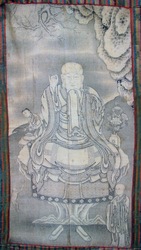
Painting Set: Lohan Set: Chinese Ink
Choying Dorje Main Page | Arhats Main PageThese paintings known in Tibetan as the Gnas brtan skya ra ma appear to be executed in an obvious Chinese black ink technique are somewhat controversial. They are claimed by some to be the work of the 10th Karmapa Choying Dorje. It is true that Choying Dorje experimented with different techniques and styles a clear example of which is his version of the Buddha's life story. However, it will be left up to the 10th Karmapa experts to determine if he also did Chinese black ink compositions.
There are three of these paintings known to be in North America. Eleven paintings remain in the Himalayan Regions. Two paintings belong to a private collector. Those two are a Guardian King and the attendant Dharmatala, therefore the remaining three Guardian Kings and Hvashang are each painted in a separate composition. The centerpiece of the set, Shakyamuni Buddha, is unaccounted for but is likely to be in a composition with Shariputra and Maudgalyayana standing at the right and left side. These calculations if correct would mean that the full set of paintings is twenty-three in number.
Jeff Watt 3-2009
A Classification of Karma sgar ris and Related Styles by Tashi Tsering
"Five remaining thang kas of the set known as the Gnas brtan skya ra ma.71. These paintings in Chinese style are not the work of Si tu. Si tu’s autobiography, (f.171b6) says: “1756…sde dger rgya thang gnas bcu bskur” and adds (f. 335b6: “1771…dngul srang bco lnga gnas brtan skya ris bdun thang sogs dang nged la mdzo sogs phul.” Are these two passages referring to the Gnas brtan skya ra ma set? The oral tradition popular with the older monks of Dpalspungs holdsthat they were offered to Si tu paṇ chen by Chinese devotees. Its five surviving paintings were hidden by the late Grub bla ye shes ’byung gnas during the Cultural Revolution;...
71 Thub bstan phun tshogs, Bod kyi mdzes rtsal gyi ri mo, in Gangs dkar ri bo, no. 2 (1985): 86."
For more information please read the article by Tashi Tsering A Classification of Karma sgar ris and Related Styles (August 2013). Also see an Alternate link.