
Item: Amitabha Buddha - Pureland (Sukhavati)
| Origin Location | Tibet |
|---|---|
| Date Range | 1500 - 1599 |
| Lineages | Sakya, Ngor (Sakya) and Buddhist |
| Size | 106.68x90.17cm (42x35.50in) |
| Material | Ground Mineral Pigment, Gold Background on Cotton |
| Collection | Private |
Classification: Deity
Appearance: Buddha
Gender: Male
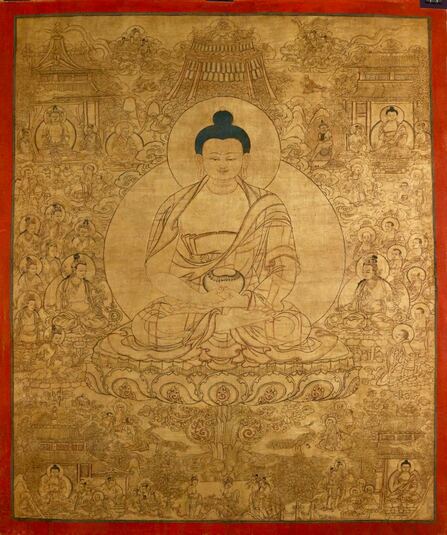
A Masterwork Painting by the Renowned Artist Trengkawa, 16th Century
Amitabha Buddha (Tibetan: san gye o pame. English: the Buddha of Boundless Light) against a gold ground following the Menri Tradition style of painting. Amitabha is associated with the pureland of Sukhavati located in the western direction. Full descriptions of his iconography and environment are found in the Mahayana Sukhavati-vyuha Sutra.
Video: Trengkawa & Gold Ground Paintings
Object & Iconography
Seated in the perfect posture of meditation, typically red in colour, with one face and two hands, dark blue hair with a top-knot ornament and the split ears of a prince. He wears the patched saffron robes of a fully ordained monk. The two hands are placed at the lap in the gesture of meditation and together hold a black begging bowl filled with nectar. With the two legs folded in vajra posture seated above a lotus seat, he is surrounded by a a large and small nimbus and aureola under a canopy barely visible mounted in a wish-fulfilling tree. Seated at the proper right and left sides are the bodhisattvas Avalokiteshvara and Vajrapani.
At the upper left side in a small temple sits Sarvavid Vairochana Buddha with four faces and two attendant figures. Slightly to the inside is an unidentified Tibetan teacher wearing a scholar's hat. At the upper right side is Medicine Buddha with two attendant figures. Slightly to the inside is the standing figure of the meditational deity Heruka Sahaja Chakrasamvara.
Surrounding Avalokiteshvara are the remainder of the Eight Great Bodhisattvas. Surrounding Vajrapani are monastic figures representing the arhats and pratyeka-buddhas. In the lower composition are two more Buddhas accompanied by many more attendant and narrative figures. It is interesting to note that below the lower figure under Avalokiteshvara at the viewer's left side there is a very small figure of the boy Sudhana Kumara, hands folded, in a kneeling posture, with the hair in tufts. He is the principal character in the famous Mahayana Gaṇḍavyūha sutra.
The general context of the composition is Amitabha Buddha seated in his pureland or pure Buddha Field of Sukhavati, also known as the Western Paradise. The two bodhisattvas to the right and left along with the other secondary figures are typical for this iconographic program. What is unique within the program is the addition of Sarvavid Maha Vairochana at the upper left and the medicine Buddha at the upper right. The Tibetan monastic figure and the meditational deity Sahaja Chakrasamvara are not typical and are a Vajrayana intrusion into an Mahayana iconographic program. This is highly unusual in traditional Tibetan Buddhism. The small figure of Sudhana at the lower left is acceptable.
Tibetan Painting Style
Gold ground paintings follow an early tradition where compositions are applied directly onto Chinese gold silk without any prepared ground. Gold ground paintings depict the same subjects as those rendered on the un-grounded silk cloth. Gold ground is commonly used for images of the Buddha who is said to 'shine like a mountain of gold.' Gold silk and painted gold ground developed independent of Tantric theory and are the result of the creativity of the artist, available materials, along with the patronage of wealthy donors. Based on a survey of examples it would seem plausible to suggest that gold ground paintings became fashionable during the Mongol Yuan period with the flow of painting and textile gifts from China to Tibet.
Five additional compositions in the style of Amitabha Buddha with the same gold ground, line work, and stylistic elements have been identified. They do not necessarily appear to be a set but rather a series of paintings by the same artist and possibly a collection of students assembled as an art atelier. The five additional paintings have the central subjects of Shri Hevajra, Chakrasamvara, the teacher Sakya Lotsawa Jampai Dorje (1485-1533), Maitreya and Chaturbhuja Lokeshvara. Some questions have been raised about the inclusion of the Maitreya composition. Alhough the measurements appear slightly narrower in width thatn other paintings, it is the quality and similarity of the drawing that is important to compare. It is already acknowledged that they are at best a series of paintings rather than a set. A set of paintings are iconographically or narratively related. A series of paintings are unrelated by subject but made at the same time according to the wishes of a donor.
All six known paintings follow in the painting tradition of Menla Dondrub who was active from early to late 15th century. Although the artist's exact dates remain unknown. Colloquially known as the Men-ri style, meaning the 'drawing [style] of Men' along with the Khyen-ri style developed by Khyentse Chenmo, these two 15th century artists, believed to be students together in their youth, set the course for Tibetan painting styles and traditions up until the current 21st century. The principal characteristics for both the Men-ri and Khyen-ri styles are open landscape with an emphasis on negative space composed of foreground and sky. Figures are placed on the canvas in a floating figure composition rather than registers popular in Nepal and West Tibet or tightly packed overlapping figures common with Indian murals and palm leaf manuscripts. China was certainly an important influence although not necessarily the most important. Between the Men-ri and the Khyen-ri there are many immediately identifiable differences in detail, decoration, and bodily proportions.
Identified Tibetan Artist
Until recently the artist for the six paintings was unknown, however while researching the set and comparing the line work, proportions and shared ornamentation with other masterworks of the 16th century it has been discovered that many of the compositions follow almost exactly with an artist's sketch book belonging to the Tibetan Dhargye Museum of Chengdu, China. The chief curator and scholar of the museum, Gendun Tenpa, studied and translated the inscriptions from the book of sketches and identified the author as Trengkawa, a famous artist of the 16th century. His name is located in a very small inscription on the last page of the sketch book. His specific dates are not currently known.
Trengkawa was known as an artist of the Men-ri painting style for both the 2nd Dalai Lama Gendun Gyatso (1476-1542 [66 yrs]) and the 3rd Dalai Lama Sonam Gyatso (1543-1588 [45 yrs]). The set or series of gold ground paintings can be associated with either the direct production of Trengkawa or in the least the artistic atelier of Trengkawa, but not however with either of the two Dalai Lamas as the subjects of most of the compositions appear to belong to the Sakya Tradition of Tibetan Buddhism.
The association of Trengkawa with the two sequential Dalai Lamas, 2nd and 3rd, is attested to in the biographies of both historical figures. It is also recorded that Trengkawa painted wall murals at Lokha Gyatsa Dzong Monastery of Southern Tibet in 1536. The monastery was destroyed in the mid 20th century and only worn fragments of the murals remain. That monastery was originally founded in 1509 by the 2nd Dalai Lama. In the 17th century, additional textual references are found in either the biography or autobiography of the Great Fifth Dalai Lama, Lobzang Gyatso (1617-1682 [65 yrs], he states clearly that he believes Trengkawa to be the superior artist when compared with the actual founder Menla Dondrub.
Jeff Watt 2-2026


Painting Type: Gold Ground
Painting Set: Buddha (Sketchbook/Gold Ground)
Collection: Bonhams, New York (March, 2026)
Collection: Bonhams, New York (Painting Masterworks, March, 2026)
Buddhist Deity: Amitabha Buddha Main Page (阿弥陀佛 / འོད་དཔག་མེད།)
Painting Set: Menri Gold Ground (Trengkawa Series)
Buddhist Deity: Amitabha Buddha, 阿弥陀佛, འོད་དཔག་མེད། (Painting Masterworks)
Painting Tradition: Menri Main Page (Style & Tradition)
Painting Tradition: Menri (Buddha Page, 15/16th Century)
Painting Tradition: Menri Masterworks