
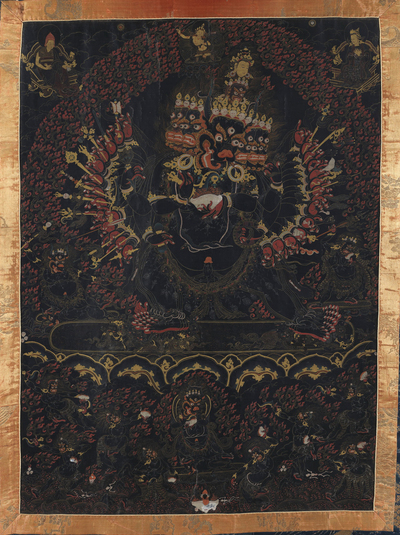
Item: Vajrabhairava (Buddhist Deity) - Solitary (Ekavira)
| Origin Location | Tibet |
|---|---|
| Date Range | 1500 - 1599 |
| Lineages | Sakya and Buddhist |
| Size | 73.66x53.34cm (29x21in) |
| Material | Ground Mineral Pigment, Black Background on Cotton |
| Collection | Private |
Classification: Deity
Appearance: Animal-Feature
Gender: Male
Ekavira Vajrabhairava (Tibetan: dor je jig je pa wo chig pa. English: The Solitary Hero Vajra Terror) a wrathful form of Manjushri.
Video: HAR #30933
Vajrabhairava, dark blue or black in colour, has nine faces, thirty-four hands and sixteen legs. The main face is that of a buffalo, with a wrathful face above and the yellow face of Manjushri placed on top. Flames shoot from the tips of the horns. There are three faces to the righjt and three to the left. Each face has three large round eyes, bared fangs and frightful expressions; brown hair flows upward like flames. The first pair of hands hold a curved knife and skullcup to the heart. The remaining hands hold a multitude of weapons with the 2nd and last set holding in addition the fresh outstretched hide of an elephant. He is adorned with bracelets, necklaces and a girdle all formed of interlaced bone ornaments, a necklace of snakes and a long necklace of fifty heads. The right legs are bent pressing down on a man, animals and various gods. The left legs are extended straight and press upon eight birds and various gods; standing above a sun disc and lotus seat completely surrounded by the red flames of pristine awareness.
At the proper right side of the central figure is Krishna Yamari, with a buffalo face, black in colour, having two hands holding a staff and a lasso, standing atop a buffalo. On the left side of the central deity is a female figure, possibly Vajra Vetali, or Oden Barma, holding a trident and a skullcup.
At the bottom center is Vajrabhairava in his Heruak form with one face and two hands, holding a curved knife and skullcup to the heart. Eight retinue figures stand to the right and left sides.
At the top center is Arapachana Manjushri, orange in colour, holding a sword and book. At the top left is Rwa Lotsawa Dorje Drag, holding a vajra and bell, wearing a red pandita hat and the robes of a monk, seated on a throne. At the top right, holding a vajra and bell crossed at the heart, wearing a crown and royal garments, is Lama Dampa Sonam Gyaltsen (1312-1375 [p1226]) belonging to the Rinchen Gang Lhabrang (Palace) of the Khon hereditary family rulers of Sakya. He was the 14th throne holder of Sakya (Sakya Tridzin) from 1345 to 1375 and was a principal student of the famous Buton Rinchen Drub of Shalu Monastery. He in turn was a teacher to Tsongkhapa, Longchenpa and Pagdrupa. The period of Sakya rule over Tibet ended with Lama Dampa Sonam Gyaltsen.
As a meditational deity Vajrabhairava, also known as Yamantaka, belongs to the Bhairava and Yamari class of tantras and specifically arises from the Vajrabhairava Root Tantra (Tibetan: jig je tsa gyu). All of those classes of related deities belong to the method (father) classification of Anuttaryoga Tantra. The practice of Vajrabhairava is common to the Sarma 'New' Schools of Tibetan Buddhism: Sakya, Kagyu, Jonang and Gelug. Among the Sakya it is counted as one of the four main tantric deities. There are numerous forms and styles of practice from the very complex with numerous deities to the very concise with a single Heruka form. The main lineages to enter Tibet were those of Jowo Atisha, Rwa Lotsawa, Mal Lotsawa and the like.
Lineage: Shri Vajrabhairava, Jnana Dakini, Mahasiddha Lalitavajra, Amoghavajra, Yeshe Jungne Bepa, Mahasiddha Padmavajra, Marmedze Srungwa, Rwa Lotsawa Dorje Drag, Rwa Chorab, Rwa Yeshe Sengge, Rwa Bum Seng, Rongpa Gwalo Namgyal Dorje, Rongpa Sherab Sengge, Lamdrepa Yeshe Palwa, etc.
Jeff Watt 2-2013 [updated 1-2026]


Subject: Black Ground Paintings (Masterworks, Sakya Atelier)
Painting Tradition: Khyenri, Black Ground
Buddhist Deity: Vajrabhairava Main Page
Painting Type: Black Ground Masterworks
Painting: Vajrabhairava (Blackground)
Buddhist Deity: Vajrabhairava (Late Painting Masterworks)
Teacher: Lama Dampa Sonam Gyaltsen
Buddhist Deity: Vajrabhairava (Painting Masterworks)
Collection of Rock Mountain Sanctuary: Painting Masterworks
Buddhist Deity: Vajrabhairava (Black Ground Masterworks)
Subject: Black Ground Paintings (Sakya Atelier)