
Item: Mandala of Pancha Raksha (Buddhist Deity)
| Origin Location | Tibet |
|---|---|
| Date Range | 1400 - 1499 |
| Lineages | Sakya, Ngor (Sakya) and Buddhist |
| Material | Ground Mineral Pigment on Cotton |
| Collection | Private |
Classification: Deity
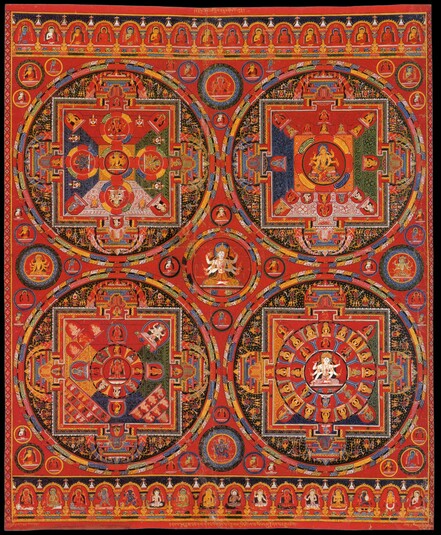
Four mandalas from the Vajravali compendium of mandalas are depicted in this painting. In the top left is the Pancha Raksha Mandala. Top right is the Vasudhara Mandala. Bottom right is the Ushnishavijaya Mandala. Bottom left is a variant of the Grahamatrika Mandala that was previously unidentified. This configuration of the Grahamatrika mandala is unique to the Ngor style of mandalas and has additional deities. This is the last painting in the set, based on the list of mandalas in the Vajravali.
The top register depicts 16 Buddhas. From left to right: The 5 Adi Buddhas (Aksobhya, Vairocana, Ratnasambhava, Amitabha, Amoghasiddhi), Sakyamuni Buddha then 10 Buddhas of the Ten Directions (the inscriptions are just the names of the directions).
Around the four main mandalas are the Five Pancharaksha Goddesses, who appear in the four cardinal directions and in the center. They are surrounded by the thirty-five Confession Buddhas and Sakyamuni Buddha.
At the bottom register are fifteen Indian gods (devas), and the donor, Ngorchen Kunga Zangpo (1382–1456) the last figure on the right whose name is inscribed. Based on the bottom inscription, he commissioned a complete painting set of the Vajravali mandalas in honor of his late teacher Sabzang Phagpa Zhonnu Lodro (1346-1412), who was one of the teachers who transmitted the Vajravali and the Kriyasamucaya compilation of mandalas into Tibet.
This is an exceptional painting for its aesthetic refinement and detail, its iconographic precision and the well-preserved inscriptions which provide historical information.
Nick Dharmadi, updated 8-2026
Front of Painting
English Translation of Inscription: Top Register: Fourteenth painting of the Vajravali
Bottom Register: May the intentions of the glorious, holy guru, Sabzang Phagpa, be completely fulfilled.


Collection: Sotheby's, Painting (March, 2000; New York)
Mandala: Four Mandala Composition
Buddhist Deity: Pancha Raksha (13 Deity Mandala)
Buddhist Deity: Pancha Raksha Art History
Buddhist Deity: Pancha Raksha (Mandalas)
Painting Set: Vajravali (Ngorchen Kunga Zangpo)
Buddhist Deity: Pancha Raksha Main Page
Buddhist Deity: Pancha Raksha (Masterworks)
Publication: Wisdom and Compassion (Painting)