
Item: Yamari, Krishna (Buddhist Deity)
| Origin Location | Central Tibet |
|---|---|
| Date Range | 1600 - 1699 |
| Lineages | Nyingma |
| Material | Ground Mineral Pigment on Cotton |
| Collection | Rainy Jin & Johnny Bai |
Classification: Deity
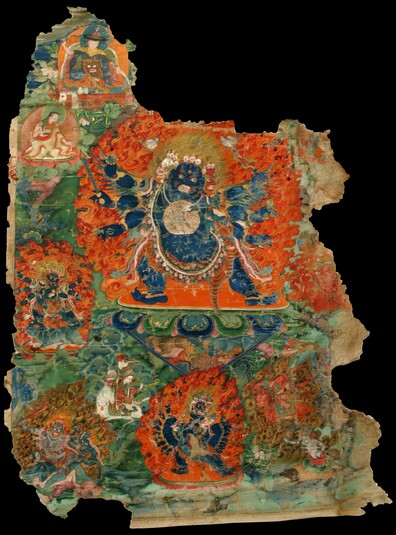
This is a Nyingma form of Krishna Yamari [gshin rje gshed] known as Manjushrī of the Suppressing Mudra ['jam dpal phyag rgya zil gnon], because Yamari is a wrathful form of Manjushri.
The central figure is Yamari with three faces, six hands, four legs and wings, in union with his consort. At his heart are three nested deities. First is Yamaraja the Killer [gsod byed], dark brown with one face and two hands, holding a heart and a weapon-wheel. In Yamaraja's heart is Vajrapani the Master of Spirits [dregs pa'i bdag], with one face and two hands holding a vajra and a garland of hearts. In Vajrapani's heart there should be a deity called Mahabhairava ['jigs byed chen po], represented by a turtle turned upside down, an animal associated with Manjushri, but this is not visible in the painting because it would be too small so the artist did not paint it.
To his proper left is the "body" emanation "Master of Death" ['chi bdag], red with four arms, with his consort, riding on a red horse. This portion of the painting is damaged.
To his proper right is the "speech" emanation, "Master of Life-force" [srog bdag], dark blue with three faces, six arms, with his consort standing on a buffalo.
Below him is the "mind" emanation, "Master of Life" [tshe bdag], dark blue with nine faces and eighteen arms, in union with his consort. This deity is very similar to Vajrabhairava in the Sarma schools, but several faces are animal heads instead. The top three are peacock, vulture, and garuda. The middle three row are standard wrathful human faces. The bottom three row are tiger, the main buffalo face, and lion.
This Nyingma form of Krishna Yamari with its unique iconography and retinue deities originates in a cycle of terma, revealed treasure texts, attributed to Nubchen Sangye Yeshe and Padmasambhava. However, the actual treasure revealer was Gya Zhangtrom [rgya zhang khrom] in the 11th century, which is a early date for a Nyingma terma. This terma cycle came to be practiced in the Northern Treasure Nyingma tradition and the Drigung Kagyu tradition. The Fifth Dalai Lama practiced it and wrote his own texts about this deity.
This painting can be securely dated to the late 17th century. Based on the reverse inscription, it was commissioned by Zantsulwa Lobzang Tseten (zan tshul pa blo bzang tshe brtan). It is most likely his handprints on the back. This name appears twice in the Fifth Dalai Lama's autobiography, and he was a certain leading monk of the tantric college whose studies and offerings of gifts the Dalai Lama noticed.
Nick Dharmadi, 9-2026
Source for Iconography and Historical Information about the Terma: Stephane Arguillere, Yamāntaka Among the Ancients: Mañjuśrī Master of Life in Context. Revue d'Etudes Tibétaines, 2024, For a Critical History of the Northern Treasures 2, 68, pp. 294-380.
Reverse of Painting
English Translation of Inscription: From the Victorious Ones of the Peaceful and Wrathful [deities] down to the eight classes of spirits, Through your fierce and majestic majesty, you overwhelm the entire host of mudras. May all arrogance and pride, along with their weapons, fall away at once, And simultaneously, let great blessings enter my heart. May all adversity be entirely pacified and the qualities of samsara and nirvana increase. May the power over both spiritual and temporal affairs be mastered, and may those who cause harm be subdued. Grant that the state of Mañjusri, both peaceful and wrathful—where activities are spontaneously accomplished and pacified—be manifestly attained in this very life. On a cotton canvas depicting Mañjusri of the Suppressing Mudra ['jam dpal phyag rgya zil gnon] surrounded by his desired deities, as a support for the faith of Lhaten Zangtsulwa Lobsang Tseten, there were scattered: relics of the Buddha; the hair and blood from the head of the Master himself; his fingernails and toenails; and the relics of numerous Buddhas, Bodhisattvas, translators, scholars, kings, ministers, and accomplished masters who have appeared throughout India, Nepal, and Tibet.
These were spread extensively over the body of the samayasattva, which was complete in all proportions and characteristics. Upon it, the sole protector of all beings, gods and humans alike—the Omniscient One who perceives the certainty of all phenomena—directly dissolved his jñanasattva form several times, thereby imbuing it with peerless and supreme blessings.
Wylie Transliteration of Inscription: zhi khro'i rgyal ba nas bzung sde brgyad bar // phyag rgya'i tshogs kun zil gnon gtum rngam gyis // tregs bsnyems mtha' dag lag cha dus gcig la// lhung dang chabs cig byin chen bdag snying zhugs// mi mthun yongs zhi 'khor 'das yon tan phel// chos srid dbang sdus gnod byed tshar gcod pa'i // las zhi lhun grub 'jam dpal zhi dang khro'i// go 'phang tshe 'dir mngon sum thob par mdzod// lha ltan zan tshul ba blo bzang tshe brtan gyi dad rten 'jam dpal phyag rgya zil gnon la 'dod lhas bskor ba'i ras gzhir sangs rgyas kyi 'phel gdung// dze nyid kyi dbu lo sku mtshal/ phyag zhabs kyi sen mos gtsos gya bal bod rnams su byon pa'i sangs rgyas byang sems/ lo pan/ rgyal blon mkhas grub mang po'i ring bsrel/ sku gdung/ sku bal dpag tu med pas khyab par byugs steng dam tshig sems dpa' tshad dang mtshan nyid thed tshang bar lha mi 'gro ba yongs kyi skyab mgon gcig pu pa chos kun nges gzigs thed mkhyen pa nyid kyis ye shes sems dpa' dngos su bstim pa lan kha yar gnad ba'i byin can bya na med pa bha


Collection of Rainy Jin & Johnny Bai
Buddhist Deity: Yamari, Krishna Main Page
Subject: Layered Deities & Figures
Buddhist Deity: Yamari, Krishna (Three Faces: Terma)