
Teacher: Ngagwang Sonam Wangchug
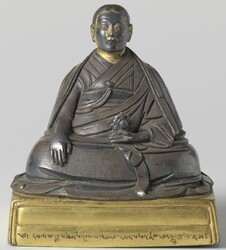
28th Sakya Tridzin, Ngagwang Sonam Wangchug (1635/38-1685 [p795]).
Ngawang Sonam Wangchuk (ngag dbang bsod nams dbang phyug) was born in 1638, the earth tiger year, at Sakya Monastery (sa skya dgon). His father was the great Sakya scholar and Twenty-seventh Sakya Tridzin, Jamgon Amnye Zhab ('jam mgon a myes zhabs, 1597-1659). His mother was named Machik Orgyen Kyabma (ma gcig o rgyan skyabs ma).
His father gave him empowerments and teachings, along with the rituals and dances that go along with those practices and tantras. By the age of twelve he is said to have become well-versed in drawing maṇḍalas and perform the related rituals. When he was thirteen his father gave him Lamdre (lam 'bras) teachings. He also studied with Sonam Wangpo (bsod nams dbang po, 1559-1621), the seventeenth abbot of Zhalu Monastery (zhwa lu dgon), and Ngawang Namgyel (ngag dbang rnam rgyal).
At the age of nineteen he married the daughter of a Sakya throne holder of one of the Sakya palaces whose name was Machik Pekar Butri (ma gcig pe dkar 'bu 'khrid). They had a son, Ngawang Kunga Tashi, who served as the Twenty-ninth Sakya Tridzin (sa skya khri 'dzin 29 ngag dbang kun dga' bkra shis, 1656-1711) from 1685 to 1711. Three other sons are mentioned in sources but not named.
Following the death of his father in 1669, at the age of thirty-one he was enthroned as the Twenty-eighth Sakya Tridzin, and office he held until his death. Six years later, at the age of thirty-seven, he traveled to Lhasa and had an audience with the Fifth Dalai Lama, Ngawang Lobzang Gyatso (tA la'i bla ma 05 ngag dbang blo bzang rgya mtsho, 1617-1682), and the two developed a friendship. Sakya sources state that the Fifth Dalai Lama encouraged him to teach that Sakya tantric traditions, and twice the Dalai Lama's government sent him on teaching tours in Southern Tibet.
After leaving Lhasa he went to Samye Monastery (bsam yas) and Mindroling (smin grol gling). There he gave empowerments and teachings to Terdak Lingpa (gter bdag gling pa, 1646-1714), such as the Hevajra Tantra. He traveled from village to village in southern Tibet giving teachings and empowerments. Returning to Tsang he spent some time at Ngor Ewaṃ Choden (ngor e waM chos ldan).
In addition to his four sons, his disciples included Jampa Ngawang Namgyel (byams pa ngag dbang rnam rgyal), the Second Dorje Drak Rigdzin, Pema Trinle (pad+ma 'phrin las, 1641-1717), and Kunga Lhundrub (kun dga' lhun grub, 1654-1726).
He passed away in 1685, the wood ox year, at the age of forty-seven.
Dirk Schmidt is Ph.D. student in Asian Languages and Cultures at the University of Wisconsin-Madison. www.dirkpschmidt.com
Published November 2015

Copyright © 2026
Himalayan Art Resources Inc.