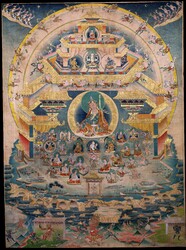
Padmasambhava: Copper Coloured Mountain History
Copper Coloured MountainIn Nyingma tradition, Zangdok Palri, the Glorious Copper-Colored Mountain, is Padmasambhava’s present abode and pure land. It is the nirmanakaya pure land manifested by Guru Padmasambhava after his departure from Greater Tibet. According to the story, after his work in Tibet, Guru Rinpoche left for the land of the rakshasas, the cannibal demons, to keep them from overrunning the human world. Transforming this perilous and hostile cannibal realm, Guru Rinpoche then manifested the extraordinary Palace of Lotus Light, Padma Ö, atop the central mountain. The location is given as the subcontinent Chamara, which is the central of a configuration of nine islands inhabited by savage rakshas. The main early textual source is the treasure literature about Padmasambhava’s life. Scholars use the material found in the closing chapters of Nyangrel Nyima Oser’s seminal biography of Padmasambhava—The Copper Palace (Tib. zangs gling ma) (twelfth century) as a starting point, and literary sources run from the twelfth through the nineteenth centuries. The fourteenth-century Pema Kathang of Orgyen Lingpa also expanded the account. Later, many tertöns recorded visionary journeys there, including Ratna Lingpa, Pema Lingpa, Jamyang Khyentse Wangpo, and Jamgön Kongtrul. A whole genre of aspiration prayers for rebirth there also grew up, by authors such as Jigme Lingpa (Secret Path to the Mountain of Glory) and Chokgyur Lingpa, whose short prayer is widely chanted.
The descriptions combine cosmic geography with mandala architecture. Jikmé Tenpé Nyima, the third Dodrupchen, describes a vast body of deep blue ocean, which looks like the sky had fallen on the earth, with the mountain rising from its center. At the summit, in the center of it all is the Palace of Lotus Light, adorned with boundless gems of all colors that radiantly shine. Its roof is golden and bedecked with bells that ring the Dharma teachings. Around it stand the Peaceful, Increasing, Magnetizing, and Wrathful Mansions to the East, South, West, and North, and the inhabitants are born miraculously from lotuses. Another description says the palace is based on an eight-sided jewel and a thousand-petaled lotus, with four gates, four arches and eight pillars. In visionary accounts it can be less solid: Pema Lingpa found an immense palace, self-arisen and transparent, with no distinction between inside and out. The palace is usually pictured with three storeys. Padmasambhava and his retinue of vidyādharas and ḍākinīs occupy the ground floor, Avalokiteśvara the middle floor, and Amitābha the top floor, matching the three kāyas. Because of this fixed imagery, this mountain-palace is depicted in many thangkas and constructed as temples and portable shrines used by manipa itinerant storytellers, and three-storey Zangdok Palri temples have been built across the Himalayas.
A few issues remain such as the common prayer places the location to the southwest, but the Rangjung Yeshe dictionary says south-east of Jambudvīpa. Lineages also differ on whether Chamara is a real place, a visionary realm, or both. The three-storey arrangement may come from general knowledge rather than textual sources.
HAR Team, 11-2026