
Subject: Hats (Shamarpa)
Karmapa Page | Karmapa Outline Page | Shamarpa | Situpa | Gyaltsab | Pawo | Lineage Painting Sets | Karma Kagyu Hats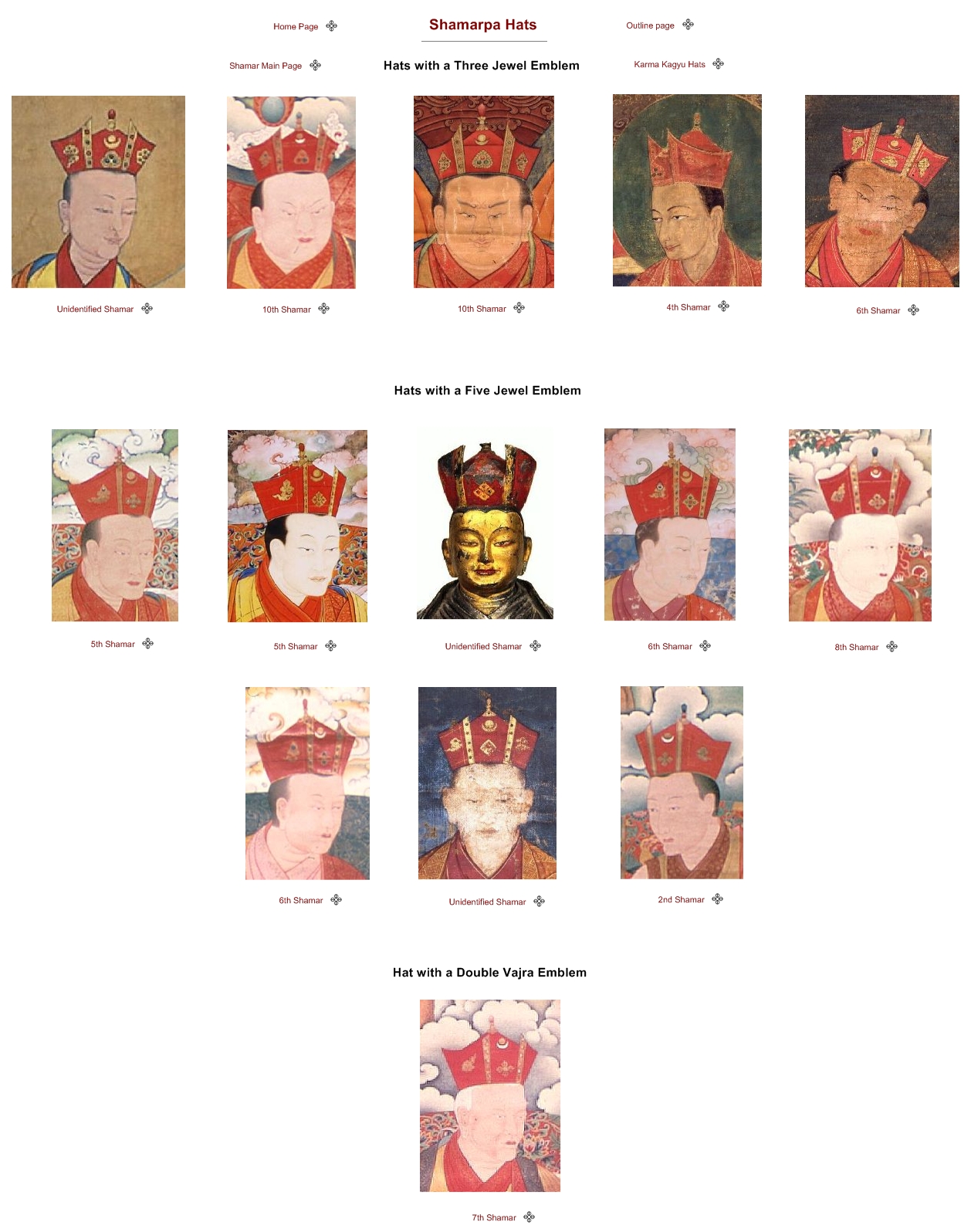 The red hat (sha marpo) of the Shamar Lamas, of the Karma Kagyu Tradition of Tibetan Buddhism, is patterned after the famous black hat of the Gyalwa Karmapas. The 1st Shamar, Dragpa Sengge (1283-1361), was the first to have a red copy of the black hat, said to be a gift from his teacher the 3rd Karmapa, Rangjung Dorje (1284-1339). Later, the Tsurpu Gyaltsab incarnations and the Tai Situ incarnations, also of the Karma Kagyu, would follow form and adopt the same basic design of the red hat, patterned on the black hat, although with slight stylistic modifications.
Characteristics of the Hat
1. Round with upturned flaps
2. Peaked with a gold finial and a large jewel
3. Front marked with an emblem below a sun and moon symbol
4. Sides decorated with cloud patterns
5. Black, red or orange in colour
The shape of the hat itself is more like a cap and similar to a Mongolian or Chinese court minister's head gear. Aside from the colour, black versus red, the cloud pattern on the side of both the Karmapa and Shamarpa hats differs slightly with the pattern of the Shamar hat placed opposite to that of the black hat. The cloud pattern of the Shamar hat, on the right and left side, almost always trails to the back, which means that the cloud pattern appears to be floating forward of the cap. The black hat pattern has the trail, or tail, of the cloud at the front of the cap.
The ornament on the front of the red Shamar hat is typically either a three jewel emblem/motif, or a five jewel emblem (the latter reminiscent of a stylized double vajra possibly imitating the double vajra of the black hat). In one instance on the HAR website there is a Shamar hat with a double vajra emblem in a painted depiction of the 7th Shamar, Yeshe Nyingpo.
For sculptural representations of the Shamar Lamas, and the red hat, often a simple flat four sided diamond shape is used as the front emblem of the cap. This is also common for sculptural depictions of the Gyalwa Karmapa, Tai Situ and Gyaltsab Lamas.
Observing 20 Shamarpa images on the HAR site, both painting and sculpture, 3 have a simple diamond shaped emblem, 6 have a three jewel emblem, 10 have a five jewel emblem, and only 1 has a double vajra emblem (vishva vajra). Typically it is the black hat of the Karmapa that has the double vajra symbol, but it is important to know that there is the official black hat that has real gold and jewel decorations and then a simple black cap made of cloth with a diamond front emblem, also of cloth, that is worn by the Karmapas for less formal occasions. These two types of hats can be confused when rendered as sculptural objects rather than as paintings.
Later, the Karmapa's regeant at Tsurpu Monastery, the Tsurpu Gyaltsab incarnation, would also adopt the red cap and generally maintaining the same identical ornamentation, double vajra etc., and cloud orientation as the black hat of the Karmapas. In some depictions of the Gyaltsab Lamas they wear an orange hat with jewels on the front.
The red hat of the Tai Situ incarnations appears to vary in colour between red and orange, most often having a three jewel emblem on the front and the cloud pattern trailing to the back. More importantly, the Tai Situ hat is also slightly different from all of the others in that it has two notches, or divots, along the top of the up-turned right and left flaps, above the cloud pattern on the sides. However, this notch is not consistent from one depiction to the next but common enough to be an important characteristic unique to the Tai Situs and their hat. Following that inconsistency, the cloud pattern of the Situ cap sometimes trails to the front and not always to the back. Although in an early 17th century painting of the 1st Tai Situ he is depicted with a red hat, not orange, and a five jewel emblem, not three, with the clouds trailing to the front, not back, and the two notches on the right and left sides of the cap clearly visible - the notches becoming more common on the Situ hats in later centuries.
It should now be quite clear that the most consistent and recognizable characteristics for all of these hats, especially for the Shamar, is that the Karmapa's hat is black, the Shamarpa's hat is red as is the Gyaltsab and sometimes the Tai Situ's hat. For the Shamarpa the most important thing to recognize is the red hat with the cloud pattern tailing towards the back and the three or five jewel emblem on the front of the hat. Aside from these few characteristics of the red hat itself the only way to tell the difference between a Shamar Lama and a Situ Lama is the hand gestures and attributes, painting composition, facial expression, and the secondary figures in a composition - all of these together.
Shamarpa Main Page
Shamarpa Outline Page
Karma Kagyu Hats Page
Jeff Watt, 2-2010