
Item: Vajrayogini (Buddhist Deity) - (Naropa Tradition)
| Origin Location | Tibet |
|---|---|
| Date Range | 1700 - 1799 |
| Lineages | Sakya and Buddhist |
| Material | Ground Mineral Pigment on Cotton |
| Collection | Private |
Classification: Deity
Appearance: Semi-Peaceful
Gender: Female
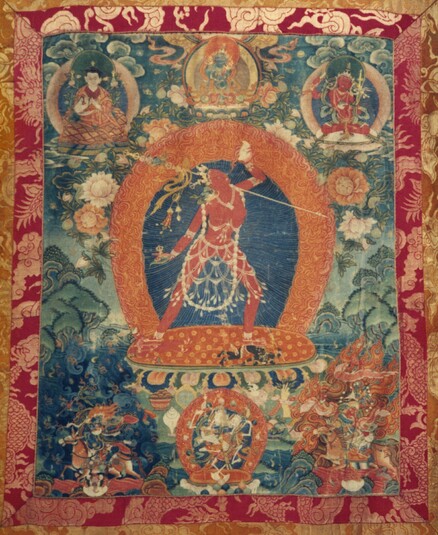
Vajrayogini according to the tradition of mahasiddha Naropa.
Video: HAR #57048
'...the form of Vajrayogini, on a multi-coloured lotus and sun seat, with the right foot extended pressing down on the breasts of red Kalaratri, left pressing on the backward bent head of black Bhairava. With a body red in colour, brilliant, like the fire at an aeon's end, one face, two hands, three eyes gazing at the pure [realm] of Khechara. The right hand holds a vajra marked curved knife extended downward, left, a blood filled skullcup held above with the face looking upward and drinking. On the left shoulder is a vajra marked katvanga [staff] with a damaru, bell and three hanging pennants. Black hair in strands extends to the waist, youthful and with large breasts of desire, in a mood generating bliss. Having a crown of five dry human skulls and a necklace of fifty; naked, adorned with five mudras, Vairochana as a crown, standing in the middle of a blazing fire of pristine awareness.' (Written by Khyabdag Nesar Ngawang Kunga Legpa'i Jungne, 1704-1761).
At the top center is the primordial Buddha Vajradhara, blue in colour. At the upper right side is Vira Vajradharma, red in colour, the special primordial Buddha of the Wisdom Tantras of the Niruttara Anuttarayoga Tantras.
At the left side is a figure wearing monastic robes, a black hat, and holding two flower blossoms supporting a vajra and bell. Although the figure appears to be male due to the horizontal hairline on the forehead, it is very possible that the figure is representing the Samding Dorje Pagmo who is often depicted with a black hat, monastic robes, along with vajra and bell attributes, or a curved knife and skullcup. There are a number of Buddhist teachers that wear a black hat as part of their special insignia or iconography. Only the Samding Dorje Pagmo line of female incarnations is known to regularly be depicted wearing a black hat.
At the bottom center is the protector deity Shri Shmashana Adhipati appearing as two dancing skeletons - the special protectors for Vajrayogini of Naropa according to the Sakya Tradition. At the viewer's left side is Shri Devi Magzor Gyalmo. On the right side is the special worldly protector deity for the Bodong Tradition and Bodong E monastery - Tashi Wobar, red in colour, appearing as a Tsen warrior. Many of these Tsen protector deities can have a very similar appearance one to the other such as Tashi Wobar, Tsiu Marpo and Tsengo Dragpa Gyaltsen.
Jeff Watt 2-2026
Bibliography:
When a Woman Becomes a Religious Dynasty, The Samding Dorje Pagmo of Tibet. Hildegard Diemberger. Columbia University, 2007.
Feast of Miracles, The Life and the Tradition of Bodong Chole Namgyal (1375/6-1451 A.D.) according to the Tibetan Texts "Feast of Miracles" and "The Lamp Illuminating the History of Bodong." Hildegard Diemberger. Porong Pema Choding Editions, 1997.
Teacher: Samding Dorje Pagmo Biography
Buddhist Deity: Vajrayogini (Main Figure)
Collection: Private 1
Buddhist Deity: Vajrayogini, Khechara (Naropa Tradition)
Subject: Black Hats & Blue Hats Main Page
Teacher: Samding Dorje Pagmo