King: Qianlong Emperor
Kings Main PageSubjects, Topics & Types:
- Description (below)
- Incarnation Lineage
- Field of Accumulation Paintings
- Painting Styles
- Selected Sculpture Figures
- Commissioned Sculpture Set
- Seven Buddhas
- Black Ground
- Masterworks
- Confusions: Panchen Lama, Changkya Rolpai Dorje
- Others...
Publications:
- Chinese Imperial Patronage, Treasures from Temples and Palaces (vol. 1)
- Chinese Imperial Patronage, Treasures from Temples and Palaces (vol. 2)
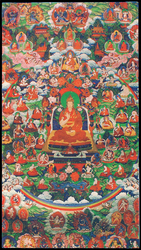
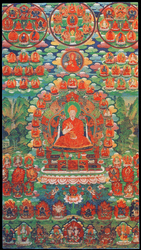
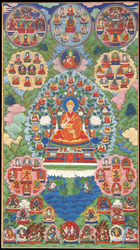
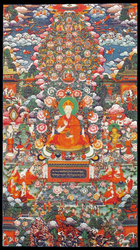
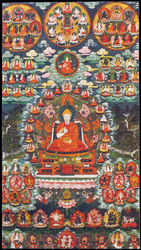
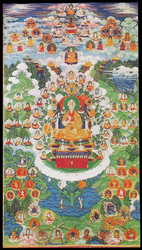
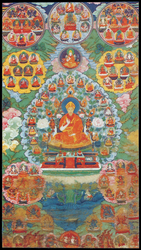
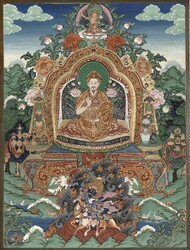
The reign of the Qianlong Emperor (r. 1735–1796) was marked by a sophisticated fusion of political authority and Buddhist sacral kingship, through which the emperor presented himself not merely as a secular ruler, but as a divinely sanctioned sovereign. Central to this self-fashioning was his identification as the incarnation of Manjushri, a claim that can be traced back to the Yuan period, when Kublai Khan was associated with Manjushri as an activity emanation—a model later adopted by successive Chinese emperors, including Yongle. By the Qing period, the title “Manjushri Great Emperor” had become firmly embedded in diplomatic discourse, appearing in correspondence from figures such as the Dalai Lama and the Panchen Lama, and Qianlong actively cultivated this identity through ritual, architecture, and visual culture. Most notably, a formally established pre-incarnation lineage— made during the Sixth Panchen Lama’s visit to Beijing in 1780—linked Qianlong to earlier Buddhist and imperial exemplars such as Muni Tsenpo and Kublai Khan, positioning the Qing emperor within a long lineage of trans-regional Buddhist rulers. Through pre-incarnation and other portraits produced during his reign, Qianlong was presented as a chakravartin, or enlightened ruler—an ideological strategy that functioned as a powerful means of legitimizing Qing rule over Tibet and Mongolia by elevating his status beyond that of a purely political figure.
Shinzo Shiratori, 1-2026