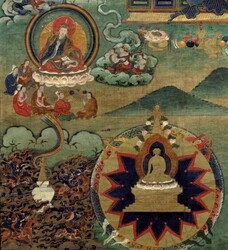
Buddhism: Northern Treasure Tradition (Jangter)
Nyingma Revealed TreasureSubjects, Topics & Types:
- Description (below)
- Godemchen
- Jatson Nyingpo
- 'Jangter' Mahakala
- Masterworks
- Confusions
- Others...
The Northern Treasures (Tibetan byang gter) is one of the major lineages of terma, or “treasure teachings,” in the Nyingma school. It takes its name from where it began: the treasures were revealed in northern Tibet, in the region of Latö Jang, by Rigdzin Gödem Ngödrup Gyaltsen (1337–1408). His name means “vulture-feathered,” because tradition says vulture feathers grew from the crown of his head. He is said to have recovered the main cache in 1366 at Zangzang Lhadrak. His most important revelation is the Gongpa Zangthal (“Unimpeded Realization of Samantabhadra”), a Dzogchen cycle that includes the widely recited Aspiration Prayer of Samantabhadra. He also revealed the “Seven Chapter” supplication to Padmasambhava, a major Vajrakilaya cycle, and guidebooks to hidden lands (beyul) such as Sikkim and Yolmo in Nepal. As with other terma, the texts are presented as teachings Padmasambhava and his circle concealed in the imperial period.
The tradition was institutionalized through a line of reincarnated lineage holders, the Rigdzin Chenmo, and found its main seat at Dorje Drak monastery in Central Tibet. Dorje Drak became one of the two great Nyingma monasteries of the region, alongside Mindroling, and both had close ties to the Fifth Dalai Lama in the seventeenth century. The lineage suffered badly in 1717, when Dzungar Mongol forces invaded Central Tibet, killed the lineage holder Pema Trinle, and damaged Nyingma institutions. It recovered afterwards and is still practiced today in Tibet, in Himalayan communities in Nepal, Sikkim and Bhutan, and in exile, where it is especially associated with ritual protection, Vajrakilaya practice and Dzogchen. (AI Assisted & Edited).
Jeff Watt 11-2026 [updated 11-2026]