
Item: Akshobhya Buddha
| Origin Location | Tibet |
|---|---|
| Lineages | Nyingma and Buddhist |
| Material | Ground Mineral Pigment on Cotton |
| Collection | Private |
Classification: Deity
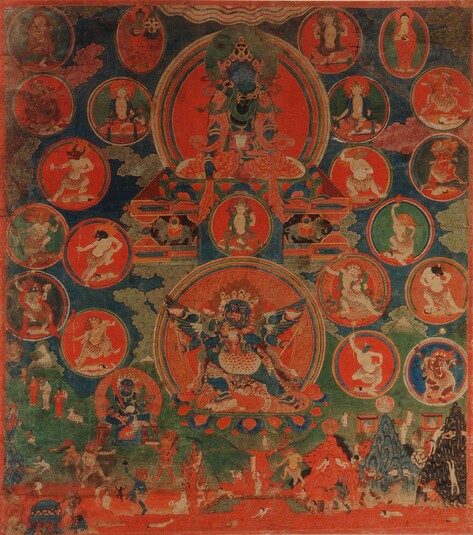
Akshobhya Buddha.
The upper central figure is Akshobhya Buddha with consort and and the lower wrathful figure is Vajra Heruka. The Heruka deity has wings which indicates that this is more likely depicting some kind of Bardo cycle of Tantric practice rather than a depiction of the deities from the Guhyagarbha Tantra. The composition belongs to a five painting set depicting the One Hundred Peaceful and Wrathful Deities of the state between death and rebirth. Along the bottom of the composition are hell scenes with a Yama figure seated to the left holding a staff, a butcher's staff, and in the right hand a mirror. At the right side there are three mountains, black, blue, and red, and a river of blood. There are all kinds of hellish scenes.
The outer border of the composition is red, or dark orange, and then yellow on the outside. This order of colour s very typical of eastern Tibet and the Amdo region of northeastern Tibet so that’s likely where this painting is from. Also, having all the secondary figures in the circles looking a little like Rainbow spheres, this is also popular in the Yushu area of Northern Kham on the border with with Amdo. So, it’s hard to say exactly where this painting is from, but it’s definitely eastern Tibet but where in eastern, whether it’s north, middle, or south, it’s a little hard to say.
Jeff Watt 7-2026
Subject: Five Buddhas (Nyingma)
Painting Set: Bardo Deities (Buddhas)
Subject: Coloured Mountains Page